Showing posts with label Free Exercise Tips. Show all posts

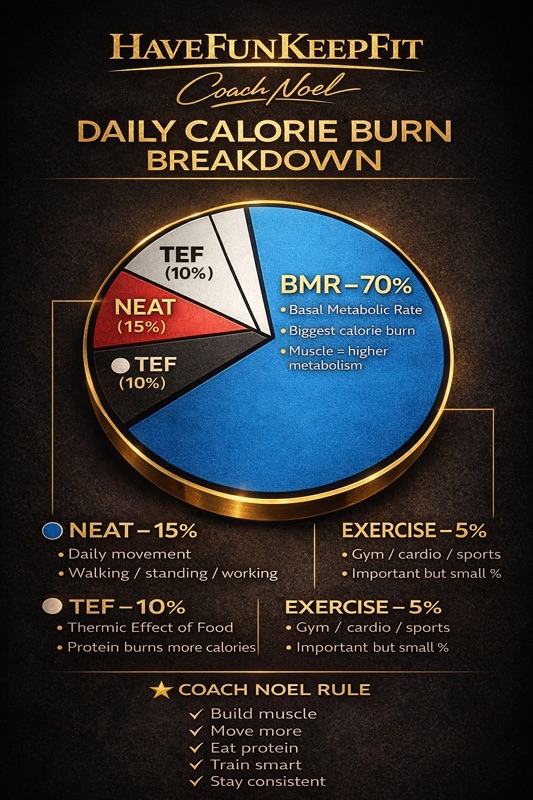
Daily Calorie Burn Breakdown

Understanding Daily Calorie Expenditure: Why Exercise Is Only a Small Part of Fat Loss

By Coach Noel – HaveFunKeepFit 


When people start a fitness journey, the most common belief is that exercise is the main factor in losing weight. While training is important for health, strength, and performance, it actually represents only a small percentage of the calories your body burns each day. To understand fat loss correctly, we must first understand how Total Daily Energy Expenditure (TDEE) works.


Total Daily Energy Expenditure is the total number of calories your body uses in one day. It is divided into four main components: Basal Metabolic Rate (BMR), Non-Exercise Activity Thermogenesis (NEAT), Thermic Effect of Food (TEF), and Exercise Activity.


The largest part of daily calorie burn comes from Basal Metabolic Rate, which accounts for approximately 60–70% of total energy expenditure. BMR refers to the calories your body needs to maintain basic life functions such as breathing, blood circulation, brain activity, hormone regulation, and organ function. This means that even at complete rest, your body is constantly burning energy to stay alive. One of the most important factors affecting BMR is muscle mass. Individuals with more lean muscle tissue burn more calories at rest, which is why resistance training plays a critical role in long-term fat loss.


The second component is Non-Exercise Activity Thermogenesis, commonly known as NEAT. This represents around 10–20% of daily calorie expenditure and includes all physical activity outside of structured exercise. Walking, standing, cleaning, working, coaching, and general movement throughout the day all contribute to NEAT. Research shows that people with higher daily movement levels burn significantly more calories even without additional workouts. Increasing NEAT is one of the most effective and sustainable ways to improve fat loss without excessive training.


The third component is the Thermic Effect of Food (TEF), which accounts for approximately 10% of daily calorie burn. TEF refers to the energy required to digest, absorb, and process the food you eat. Different macronutrients require different amounts of energy to digest. Protein has the highest thermic effect, meaning the body burns more calories processing protein compared to carbohydrates and fats. This is one reason high-protein diets are recommended for fat loss, muscle preservation, and metabolic health.


The final component is Exercise Activity, which typically represents only about 5% of total daily calorie expenditure for most people. This includes gym workouts, cardio sessions, sports, and structured training programs. While exercise is essential for building muscle, improving cardiovascular health, and enhancing physical performance, it is not the primary driver of fat loss. Many individuals overestimate how many calories they burn during workouts and underestimate the importance of daily habits, nutrition, and muscle mass.


For effective and sustainable fat loss, the focus should not be only on exercise. A successful fitness program should aim to increase muscle mass to raise BMR, maintain high daily activity to improve NEAT, consume enough protein to maximize TEF, and use exercise as a tool for strength, conditioning, and long-term health.


This approach is the foundation of the HaveFunKeepFit Coaching System, where the goal is not only weight loss, but also strength, longevity, metabolic health, and consistency. Understanding how your body truly burns calories allows you to train smarter, eat better, and achieve results that last.


— Coach Noel / HaveFunKeepFit 

Fat Loss • Strength • Health • Longevity


#HaveFunKeepFit

#CoachNoel

#FitnessEducation

#FatLossScience

#Metabolism

#StrengthTraining

#PersonalTraining

#FitnessCoach

#HealthAndFitness

#WeightLossGuide

#FitnessArticle

#GymEducation

#OnlineCoaching

#FitLifestyle

#LongevityFitness


@HaveFunKeepFit

@CoachNoel

@HaveFunKeepFitCoaching

@CoachNoelFitness

@HaveFunKeepFitOfficial

@CoachNoelTraining

The Time Under Tension For Ideal Ranges

 The Time Under Tension For Ideal Ranges

Varying the tempo on an exercise to manipulate the time under tension (TUT) is an excellent tool for building muscle and busting plateaus. It is also a great trick for making your in-home workouts more challenging if you are limited to a few lightweight dumbbells.

The Time Under Tension For Ideal Ranges

TUT is commonly used in strength training and bodybuilding as a way of calculating the total amount of work you place on a muscle. It refers to the total time a muscle is under strain during each set.

For example, a typical set of 8 reps on the barbell curl for the average lifter may take about 16 seconds. 1 second to lift the weight, 1 second to lower weight. Most people just move the weight as fast as possible.

However, various studies have shown that slowing the tempo, particularly on the eccentric portion of a movement (the lowering portion when your muscle is slowly elongating) provides a stimulus to the muscle that can trigger adaptations leading to higher rates of protein synthesis and muscle development.

In other words, by putting a muscle under longer bouts of strain, you can cause extensive muscle breakdown leading to greater muscle growth.

Take the same 8 reps on the barbell curl and slow down the eccentric portion (lowering the barbell) to 3 seconds, and now your total time under tension goes from 16 to 42 seconds.

The number of reps and the amount of weight have not changed, yet in the second example, you spent more than double the amount of time under tension. That is the basis of TUT training.

The Time Under Tension For Ideal Ranges

Focus on sets that last for a certain amount of time, based on your training goals while still maintaining good form and full range of motion. You will probably find out that as you slow down the movement, you will need to go lighter in weight or use drop sets to complete the last few reps without stopping.

 Sharing in caring...

Top 5 Shoulder Exercises for Rapid Shoulder Growth


Top 5 Shoulder Exercises for Rapid Shoulder Growth


Top 5 Shoulder Exercises for Rapid Shoulder Growth 


We'll look at the top 5 shoulder exercises to help you grow your shoulders faster in this blog.
Let's start with some exercises. Your gym guides are always there to assist you at any moment.

1. Front Raise using Dumbbells:


Top 5 Shoulder Exercises for Rapid Shoulder Growth


* Pick up a pair of dumbbells and place them in front of your thighs at arms length, palms facing your thighs.

* Lift the left dumbbell to the front with a slight bend in the elbow and the palms of the hands always facing down while keeping the torso steady (no swinging). Continue to raise your arm until it is just above parallel to the ground.

* Now slowly lower the dumbbell to its starting position while simultaneously lifting the right dumbbell.

* Perform three sets of 15 reps of this shoulder front raise workout.


2. Lateral Dumbbell Raise:


Top 5 Shoulder Exercises for Rapid Shoulder Growth


* Choose a pair of dumbbells and stand with your body straight and the dumbbells at your side at arms length, palms facing you.

* Lift the dumbbells to your side with a small bend in the elbow and hands slightly tilted forward while keeping your torso steady (no swinging). Continue to raise your arms until they are parallel to the floor.

* As you inhale, slowly lower the dumbbells back to the beginning position.

* 10 reps with 3 sets is the recommended amount of repetitions.

3. Shoulder push-ups using a barbell:

Top 5 Shoulder Exercises for Rapid Shoulder Growth


* Stand or sit with your feet shoulder-width apart and your elbows pointed forward, gripping the bar with your fingertips.

* The bar should be resting on the front of your shoulders.

* Squat down and center your weight under the barbell in a shallow squat.

* Your heels should be pressed up.

* Raise the bar above your head until your arms are completely straight.

* Lower the bar to your chest level.


4. Reverse Flyers are a great way to get your message through in a different way

Top 5 Shoulder Exercises for Rapid Shoulder Growth


* Grab a pair of dumbbells and bend your hips forward until your body is nearly equal to the floor.

* Maintain a shoulder-width distance between your feet. Allow the dumbbells to hang straight down from your shoulders with your arms slightly bent, palms facing each other.

* Raise your arms straight out to the sides until they're in line with your body, keeping your back flat and your torso still. Do not alter the angle of your elbows. Return to the starting position after a brief pause.

* Rep this shoulder exercise three times for a total of ten reps.

5. Arnold Press / Up lift :


Top 5 Shoulder Exercises for Rapid Shoulder Growth


* Hold a pair of weights in front of your shoulders with your hands facing your body. (Begin in a position that looks like the top of a dumbbell curl.)

* If you have lower-back difficulties or are just getting started, execute this move on a back-supporting chair or bench.

* Start with a lighter weight than you would for overhead dumbbell presses; you can easily increase the weight later.

* 3 sets of 15 reps of the Arnold press shoulder exercise


Sharing is caring...

Pineapple Mango Rum Punch

Formula on a pineapple mango rum punch that will make you have an inclination that you're in the Caribbean.


SideEffect

 Here's the formula for pineapple mango rum punch…


Ingredients :

3 oz of pineapple coconut juice
3 oz of coconut rum (you can also use light or dark rum here instead)
1 oz of mango juice
1 oz of orange juice
splash of grenadine (mainly just for looks)
lime slices and/or orange zest for garnish edible flowers for garnish

Combine all juices (pineapple coconut, mango, and orange) and rum. Then stir. Pour over ice and add a splash of grenadine for color. The grenadine will fall to the bottom and give the drink a pretty ombre look. Then, add lime, orange zest, and edible flowers for garnish.

Beer And Bodybuilding


Beer is very popular among the strong half of humanity. Beer is also loved by some athletes, although practically everyone knows that alcohol is not harmless to health and for athletes even more so. And yet most bodybuilders practice drinking a glass of beer, especially on Sundays. How bad it is, or maybe it’s good, it is necessary to understand this issue.

Any alcoholic beverage contains ethanol. In addition, the main property of alcohol is the provision of an inhibitory effect on the receptors of the central nervous system. Alcohol ethanol, contained in alcohol, has a psychoactive effect.

Any bodybuilder should know that any alcohol and bodybuilding are incompatible due to the negative impact on muscle mass and strength. According to scientific studies, the negative effect of any alcohol on a person who is regularly trained is as follows:

1. The use of any alcohol to the state of easy intoxication is equivalent to skipping one exercise.

2. The use of any alcohol to the state of strong intoxication is equivalent to the effect on the muscles of a pass for almost half a month of training.

3.Sistematicheskaya use of any alcohol, including beer, at least 0.5 liters per day leads to a 100% reduction in muscle growth.

All these negative effects on muscle mass are due to the physiological processes taking place in the cell, under the influence of the alkaloids. In healthy, training men after a single use of a glass of beer, testosterone levels dropped significantly and the level of the estrogen hormone increased. This is due to the fact that the beer contains hops, which is an activator of the increase in estrogen in the body of a man. Accordingly, by raising the level of female hormones, the body reduces the content of the male hormone testosterone , because of which the strength decreases. In this regard, we can conclude that beer and bodybuilding. Like any other alcohol is simply incompatible.


getty image

In addition to reducing testosterone, alcohol affects the release of growth hormone, which is responsible for the growth of muscle mass. Growth hormone shows a minimum content for at least two days after taking alcohol.

Another negative factor of the effect of alcohol on the body is fat formation. Especially affects the process of formation of fat cells drinks containing yeast, in particular beer. In addition, do not forget that any alcoholic beverage is a high-calorie product.

All these facts are a direct refutation of the popular belief that it is possible to combine beer and bodybuilding. Allegedly beer along with sour cream helps to increase muscle mass. From all the above, it follows that this opinion is erroneous. And for a seriously training person, the use of any alcohol is a way to regress.
Beer and sports

Since beer refers to an alcoholic beverage, its use adversely affects the results of sports training. For bodybuilders, it is dangerous to reduce the speed of muscle mass gain, decrease in strength characteristics, and slow the recovery process. Based on research conducted by scientists, we can safely say that:
drinking beer, when you feel a slight alcoholic intoxication, is equivalent to skipping one workout;
in the case of apparent intoxication, the reduction of force data should be expected, and the recovery process may last a couple of weeks;
if the beer is consumed on a regular basis, even after a day, it leads to stagnation and a decrease in the growth of muscle tissue by 100%.
Effects of beer intake in bodybuilding

In bodybuilding, as in any other sport, the use of beer leads to the manifestation of negative effects, for example:
-> The level of testosterone decreases and this leads to a slowdown in muscle growth, since any alcohol and beer, including, stimulates the secretion of catabolic hormones;
-> The level of potency decreases, as the level of testosterone decreases and the level of ceresol increases;
-> The level of estrogen increases, as the female sex hormones are contained in the beer, and this leads to the deposition of excess fat, reduced potency, fatigue, slower muscle growth, reduced strength data, the appearance of gynecomastia and other problems
-> The superfluous fat is postponed also thanks to high caloric content of beer
-> Normal sleep patterns and recovery process are disrupted
-> Deteriorates the quality of sperm.

From the above, it should be concluded that beer in bodybuilding has a negative effect on the training process. As for the positive qualities, they simply do not exist.

Nonalcoholic beer in bodybuilding

Naturally, the use of beer, especially alcohol-free, reduces the harmful effect on the body of athletes, but not completely, because high caloric content and high estrogen content remains.

In this regard, it can be argued that non-alcoholic beer negatively affects the body, by depositing fatty tissues.


getty image

There is another factor that has a significant impact – this is the quality of both non-alcoholic and alcoholic beers. Especially it concerns the domestic manufacturer, because sometimes the prices for beer are rather doubtful, which indicates their low quality. As for European countries, the situation here is somewhat better and the quality of food products is controlled accordingly. Despite this, even high-quality beer is not recommended for athletes, if they want to achieve high results in sports.
Dependence on beer

Do not discount the fact that alcohol has a narcotic effect on the human body. Dependence on beer is not a fictitious myth of fighters for a healthy lifestyle, but a scientifically proven phenomenon. Therefore, do not forget not only the negative effect, but also that excessive beer craze leads to dependence on this drink. This dependence is difficult to track, since retraction is carried out gradually and is practically not noticeable for the athlete. First he drinks a cup a month, then a cup a week and, finally, the athlete starts practicing almost daily beer.

Knowing the results, we can safely say that the use of beer, including non-alcoholic beer, deprives the athlete of any chance of high sports results. Unfortunately, this problem has a broader concept, since alcohol affects not only sports performance, but also normal family life, has a negative impact on the financial situation. Therefore, not only on weekends, but also on holidays it is better to give preference to juices or compotes.

To correctly combine alcohol and physical activity, you should adhere to the following tips:

So, beer versus bodybuilding – is it possible to combine, and if so, how?
1. You can’t work out for two days after drinking beer, this period it is very easy to crush the muscles;
2. Do not to drink alcohol for a couple of days after hard workout, as this eliminates the positive effect of workout plan;
3. Choose some foods that contain amounts of protein so it can reduce the bad effects of beer on muscles.
4. Drink a lot of mineral water use ascorbic acid to restore water balance the next morning after beer.

Conclusion about beer and bodybuilding: It will do more harm than good, so if you want to to maintain your health, many doctors recommend a pause of two days between workout and drinking beer.

Sharing is caring...

A Diet & Exercise Plan for a 60-Year-Old Woman

A combination of diet and exercise changes is the most effective way for post-menopausal women to lose weight and body fat, according to a study published in Obesity in 2012. Eating fewer calories while maintaining a high intake of protein and fiber and exercising about an hour each day are among the more effective changes you can make for weight loss. Check with your doctor before starting this new plan, however, to make sure it is safe for you.

A Diet & Exercise Plan For A 60-year-old Woman | LIVESTRONG.COM

Estimated Calorie Needs for a 60-Year-Old Woman

Your metabolism slows as you age, so you'll likely need to work harder to lose weight than you did in your 20s and 30s. After age 20, your metabolism decreases by about 2 or 3 percent each decade, mostly due to losing muscle mass. Decreasing caloric intake by about 150 calories every 10 years may help limit weight gain caused by this slowdown.

How many calories you should eat per day to maintain your weight varies based on activity level. A 60-year-old woman who isn't active needs about 1,600 calories per day, one who is moderately active needs about 1,800 calories per day and one who is active typically needs between 2,000 and 2,200 calories per day. To lose about 1 pound per week, you need to get 500 fewer calories than you burn each day. That could mean eating 500 fewer calories than your needs, burning an extra 500 calories through exercise or some combination of the two. Never eat fewer than 1,200 calories daily or you'll risk nutrient deficiencies -- if you're sedentary and need just 1,600 calories daily to maintain your weight, you could cut your calorie intake by 400 calories and burn the extra 100 calories through exercise.

Sample Diet for a 60-Year-Old Woman

The U.S. Department of Agriculture recommends a person of this age needing about 1,600 calories per day eat 1.5 cups of fruit, 2 cups of vegetables, 5 ounces of grains, 5 ounces of protein-rich foods and the equivalent of 3 cups of fat-free milk in dairy products each day.
Protein sources should be lean, such as seafood, skinless poultry, eggs and legumes, and grains should be whole grains. Try to get 25 to 30 grams of protein in each meal, as this may help decrease muscle loss. Avoid "junk" foods high in saturated or trans fats, as well as added sugars -- these foods are often loaded with calories but offer little nutritional value.
Advertisement
A sample day could include a breakfast of an orange or a cup of berries, a cup of oatmeal and a cup of nonfat yogurt. For lunch, try 2 ounces of turkey and 1 ounce of cheese on two slices of whole-grain bread served with a cup of salad and an apple. Dinner could be 3 ounces of tuna, 1 cup cooked broccoli, a glass of milk and 1/2 cup of quinoa.

Recommended Aerobic Exercise

The minimum recommended aerobic exercise for older adults is two hours and 30 minutes per week of moderate exercise, but for weight loss, you'll need to get about twice that much exercise. Try to participate in some form of aerobic exercise, such as walking or swimming, for an hour most days of the week. Women who aren't as fit can break this down into multiple segments of 10 or more minutes of exercise spread throughout the day.
Exercise should be difficult enough that you can talk but not sing. A 154-pound person burns about 280 calories per hour of walking at 3.5 miles per hour and 290 calories per hour of biking at less than 10 miles per hour. This can make a big dent in the 500-calorie-per-day deficit needed to lose 1 pound per week.

Importance of Strength Training

While participating in strength-training workouts may not burn a lot of calories, it can help older adults minimize muscle loss and decreases in metabolism. Once adults turn 30, they lose between 3 and 8 percent of their muscle mass every 10 years if they don't participate in strength training. Strength training may also help older women maintain their bone density and improve their balance and coordination, which makes it easier for them to remain independent for longer and helps prevent falls.
Aim to complete at least two of these workouts per week, including 10 to 15 repetitions of exercises that target the arms, chest, shoulders, back, abdomen, legs and hips.
Don't work the same muscles two days in a row to avoid overtraining, and get creative with at-home workouts using soup cans or water bottles as light weights. As the exercises get easier, increase the weight so that it is difficult to complete the exercise eight times in a row -- once you can complete eight repetitions, up the weight again to continue your progress.

Sample Strength-Training Exercises

Squeezing a tennis ball as hard as you can for about five seconds at a time can help improve your hand strength, while doing wrist curls while resting your forearm on the arm of a chair and holding a weight can increase your wrist strength. Arm curls, arm raises to the side and the front and overhead arm raises that start with your arms bent and your hands at your shoulders all improve arm strength. Other arm exercises include seated rows, chair dips and elbow extensions.
You can improve chest strength by doing wall pushups, and raising your legs behind you or to the side while holding onto a chair for balance will help strengthen your legs.
Knee curls, standing up from sitting on a chair and raising yourself up so you're standing on your toes are also good ways to increase leg strength. Stepping onto and off of a step while holding the handrail for balance is another good leg-strengthening exercise, and you can strengthen your abdominals and rear end by lying on the floor with your knees bent and raising your hips to do pelvic tilts. Lying on your stomach and raising your head as well as opposite arms and legs also strengthens your back.

BCAAS AND MUSCLE GROWTH: COMPLETE SENSE, OR NONSENSE?

PROTEIN AND BCAA BASICS

Protein is part of every cell in the body. In addition to making enzymes, hormones, and other body chemicals, protein is an important building block of bones, muscles, cartilage, skin, and blood. Protein is made up of 20 amino acids, 9 of which can’t be produced by the body in physiologically sufficient amounts. These 9 amino acids are called essential amino acids (EAAs) and must be supplied by the diet. The other 11 amino acids are called nonessential amino acids (NEAAs); the body can manufacture NEAAs in sufficient amounts and, thus, NEAAs need not be a dietary focus. Muscle protein synthesis, or building muscle protein, has the same amino acid requirements as building any other protein in the body. Since the body can manufacture NEAAs on its own, the ingestion of NEAAs is generally a non-issue for promoting muscle protein synthesis; the limiting factor for muscle protein creation is consuming the EAAs in sufficient quantitie.
Because isoleucine, leucine, and valine possess a branched side chain in their molecular structure, these three amino acids are called branched-chain amino acids (BCAAs); BCAAs are, also, 3 of the 9 EAAs.  
The three BCAAs, collectively, make up 35–40% of the total body amino acid pool. BCAAs are plentiful inside muscle tissue and are also preferentially metabolized there, whereas the other EAAs are mostly metabolized in the gut or liver. 
Over the past 3.5 decades, there has been a plethora of data put forward suggesting that BCAAs have a unique ability to stimulate muscle protein synthesis (MPS),  More recently, it has been reported that leucine, one of the three BCAAs, also makes a unique contribution towards MPS stimulation, primarily due to its special role in regulating intracellular signaling pathways. Let’s take a deeper look at these claims.

ANIMALS VS. HUMANS AND LEUCINE

Much of the research demonstrating an ergogenic impact of BCAAs on MPS has been performed in rodents, using procedures and relative infusion quantities that have little applicability in humans. Additionally, there are clear differences in physiology and signaling pathways between rats and humans, which limits the applicability of rodent-driven results. Although relevant, the discussion on BCAA and, specifically, leucine ergogenicity will focus on human studies.
When sub-optimal amounts of protein are consumed, adding leucine can help to optimize MPS, particularly in individuals with increased anabolic resistance, like older individuals. In a recent study by Atherton et al., 4.2g leucine added to a sub-optimal protein dose immediately following resistance exercise enhanced MPS in men, both young and old. However, when EAAs are administered in excessive quantities, adding extra leucine to the mix may not provide additional benefit.
In a few older experiments by Louard et al., 10 healthy subjects were intravenously infused with BCAAs for 3 hours. When MPS and muscle protein breakdown (MPB) were both reduced, the net muscle protein balance remained negative, resulting in a catabolic state. Five years later, the same research group conducted a similar experiment, but this time infused the subjects with BCAAs for 16 hours. The findings in this experiment were like those of the first; MPS, MPB, and ultimately, muscle protein turnover was reduced, allowing catabolism to persist. Ironically, the infusion of BCAAs in these experiments resulted in MPS decreases, not increases, equating to an overall catabolic effect. In neither of these studies was there a shift from the catabolic to anabolic state. A similar study was done by Nair et al., but with one major difference; leucine was infused, as opposed to all three BCAAs. When leucine was administered alone, there was no change in MPS but there was a significant reduction in MPB, equating to an overall anabolic effect.

THE RATE LIMITING AMINO ACID

The concept of the “rate limiting amino acid” is important to understand prior to going any further. When your diet is deficient in even a single EAA, the other amino acids that exist in excess will be degraded for other purposes (not muscle-building).You need all EAAs for them to be useful for muscle protein synthesis. The significance of the “limiting amino acid” for promoting MPS cannot be overstated; scores developed by researchers to estimate protein quality  and amino acid requirements in human are based on the concept of the “limiting amino acid.” As discussed in the aforementioned studies, providing the body with such a large disproportion of amino acids (i.e. the infusion of massive quantities of BCAAs into the body) results in a disproportionate amino acid “pool” in the body and the synthesis of new protein is limited, not by the BCAAs, but by the most deficient EAA in the “pool” at that time. You can ingest countless amounts of BCAAs, but if the body is deficient in even a single EAA, MPS will be limited.
Let’s say you have a box of puzzle pieces. Your goal is to make as many puzzles as possible. If you have hundreds of end pieces, but only a few middle pieces, you will be limited in how many puzzles you can complete by the small number of middle pieces you have available. No matter how many end pieces you have, you cannot complete additional puzzles without middle pieces. How does this apply to BCAAs and protein synthesis? If you supply the body with a plethora of BCAAs, but you have a limited quantity of the other EAAs, muscle protein synthesis (MPS) will be limited by the lack of the other EAAs. A disproportionately large intake of BCAAs without the remaining EAAs necessary to make a complete protein limits the body’s ability to build muscle (and thus, hampers muscle protein synthesis).

HUMAN PHYSIOLOGY AND BCAA ERGOGENICITY FOR MUSCLE GROWTH DON’T MIX

Muscle protein is in a constant state of turnover. In other words, new protein is continuously being synthesized while older proteins are being broken down. Muscle growth/gain occurs when the body is in an anabolic state (i.e. the rate of protein synthesis exceeds the rate of protein breakdown). Muscle losses occur when the opposite occurs and the body is in a catabolic state (i.e. the rate of muscle protein breakdown exceeds the rate of protein synthesis). The primary purpose of BCAA ingestion, or any protein ingestion for that matter, is to maximize the anabolic state of the body. If BCAAs promoted the anabolic state, this would only be possible if there were sufficient quantities of the other EAAs in order for the body to synthesize new protein. Following a meal (post-prandial state) containing a complete protein source, all EAAs are provided in sufficient quantities for the body to utilize, immediately. On the flip side, when hours have gone by without protein intake (post-absorptive state), muscle chips in to help support the energy demands of the body, and only a limited quantity of these released EAAs are available from the muscle tissue breakdown.
Some of the EAAs released from muscle protein breakdown are partially oxidized within muscle, rendering them unavailable for new muscle protein synthesis. In respect to the BCAA discussion, the EAAs released from muscle that become partially oxidized within muscle can’t be used with the ingested BCAAs to create new protein. The EAAs that are released from muscle tissue that ultimately end up in the free amino acid pool can be used with ingested BCAAs for synthesis of new proteins. It should be noted that muscle protein breakdown (MPB) increases to an even larger degree following exercise, particularly resistance exercise, and this increase is generally more pronounced in untrained individuals.

A LITTLE BIT OF RESEARCH IN HUMANS

In a recent study by Jackman et al. (2017), 11 healthy, resistance-trained young men performed muscle-damaging exercise followed by 5.6g BCAA ingestion. Ingesting BCAAs following exercise increased MPS by 22%, compared with placebo. This stimulation of MPS is far from maximal, which the authors theorize was due to lack of sufficient EAA alongside the BCAA. It’s impossible to be in an anabolic state, even with BCAA ingestion, when the other EAAs (necessary for MPS) are derived from muscle breakdown. An anabolic state cannot occur in the absence of exogenous amino acid intake. BCAAs are thought to stimulate MPS because it they have been reported to stimulate anabolic signaling cascades involved in MPS. However, the measurement of actual MPS was absent from the study design and, as discussed previously, MPS takes place only when there are ample quantities of all required EAAs. In fact, a low dose (3 grams) of EAAs can stimulate MPS without affecting components of the anabolic signaling cascade. Additionally, the anabolic signaling cascade can be stimulated without coinciding MPS. For example, glucose ingestion can stimulate insulin, which increases anabolic signaling without any coinciding increase in MPS (due to EAA deficiency). Given the aforementioned research and our knowledge of nutritional biochemistry concepts, it’s not farfetched to presume that MPS is limited by availability of all of the EAAs as opposed to anabolic signaling factor activity.

BCAAS COMBINED WITH OTHER NUTRIENTS

When added to a carbohydrate drink, high concentrations of BCAAs in an incomplete amino acid solution showed no benefit for MPS. However, when consumed with a complete protein source (i.e. whey, in this study), additional BCAAs increased MPS. These results likely indicate that one or more of the BCAAs were the rate-limiting amino acid(s) for the stimulation of muscle protein synthesis from whey protein ingestion. In light of what we know, these results make sense; sufficient EAAs are provided via whey protein, which allows for increased MPS, whereas carbohydrate may promote anabolic signaling factors but does not provide sufficient quantities of all EAAs. Other than the unlikely scenario where isoleucine or valine is the rate-limiting amino acid for MPS, there’s no advantage to consuming the three BCAAs collectively over leucine alone. In fact, it appears that the beneficial effects on muscle protein turnover observed with BCAA supplementation is due to the leucine content.

POTENTIAL BCAA ERGOGENICITY FOR EXERCISE RECOVERY?

Although BCAAs don’t appear to positively impact muscle anabolism, there’s very limited evidence that BCAA consumption can promote recovery through reduced muscle damage and soreness, and faster recuperation of force production capabilities following exercise. For example, Jackman et al. (2010) observed attenuated muscle soreness, but not muscle function, when untrained males consumed ~14g BCAA/day in the 3 days following muscle-damaging exercise . Howatson et al. (2012) reported reductions in muscle soreness, damage (i.e. creatine kinase), and faster recuperation of muscle function following muscle-damaging exercise when resistance-trained males consumed 20g BCAA/day for the 7 days prior and 5 days following the exercise bout (12 days of supplementation, total), . A recent systematic review suggests that there may be potential benefits when an array of supplementation criteria is met :
Frequency: at least 2x/day dosesQuantity: at least 200 mg/kg/day of BCAA (14 g/day for a 70kg individual)Duration: >10 daysDegree of Damage: low-to-moderate degree of muscle damage
Although there’s a growing body of literature supporting the ability of BCAAs to mitigate outcomes surrounding muscle damage, the jury is still out. In a recent position statement by the International Society of Sports Nutrition, the authors determined that more research is needed to fully determine the ergogenic impact, if any, of BCAAs.

SUMMARY

Given the current evidence, the chances of BCAAs alone stimulating MPS to a physiologically-relevant extent is unlikely in humans. If BCAAs are ingested, a small rise in MPS is certainly possible, but the availability of the other EAAs will quickly become rate-limiting for sustained stimulation of MPS. Current evidence suggests that BCAA administration is not a standalone solution for promoting muscle anabolism in humans. Here are a few summary points:
Muscle protein is made up of 20 amino acids, 9 of which must be supplied by the diet (essential amino acids; EAAs)The branched-chain amino acids (BCAAs) are isoleucine, leucine, and valine, and they are 3 of the 9 EAAsIn rodents, administration of excessive BCAA quantities may promote muscle protein synthesis (MPS)In humans, BCAA administration likely does not enhance MPS, and may even reduce it, resulting in a neutral, or net negative protein balance (catabolism)Although BCAAs stimulate enzymes that are part of the anabolic signaling cascade, this does not necessarily translate directly to muscle anabolismAll EAAs, including the BCAAs, are required in sufficient quantities for MPS, and anabolism, to occurIf a diet is inadequate in any EAA, MPS cannot proceed beyond the rate at which that particular amino acid is available. This amino acid is called the rate-limiting amino acidWhen co-ingested with other EAAs (i.e. protein), BCAAs may increase MPS if one of the three BCAAs is the rate-limiting amino acidBCAA administration may reduce muscle damage if a substantial number of supplementation criteria are met (most of which are unpractical)In my opinion, although BCAA ingestion will do no harm, the cost of BCAA supplementation does not match up with the potential, minuscule, benefit that BCAAs provide for muscle growth 

REFERENCE

Tipton, K.D., Gurkin, B.E., Matin, S. and Wolfe, R.R., 1999. Nonessential amino acids are not necessary to stimulate net muscle protein synthesis in healthy volunteers. The Journal of nutritional biochemistry, 10(2), pp.89-95.Tipton, K.D., Ferrando, A.A., Phillips, S.M., Doyle Jr, D. and Wolfe, R.R., 1999. Postexercise net protein synthesis in human muscle from orally administered amino acids. American Journal of Physiology-Endocrinology And Metabolism, 276(4), pp.E628-E634.Volpi, E., Kobayashi, H., Sheffield-Moore, M., Mittendorfer, B. and Wolfe, R.R., 2003. Essential amino acids are primarily responsible for the amino acid stimulation of muscle protein anabolism in healthy elderly adults. The American journal of clinical nutrition, 78(2), pp.250-258.Smith, K., Reynolds, N., Downie, S., Patel, A., and Rennie, M. J. (1998). Effects of flooding amino acids on incorporation of labeled amino acids into human muscle protein. Am. J. Physiol. 275, E73–E78.Børsheim, E., Tipton, K.D., Wolf, S.E. and Wolfe, R.R., 2002. Essential amino acids and muscle protein recovery from resistance exercise. American Journal of Physiology-Endocrinology And Metabolism, 283(4), pp.E648-E657.Yoshizawa, F., 2012. New therapeutic strategy for amino acid medicine: notable functions of branched chain amino acids as biological regulators. Journal of pharmacological sciences, 118(2), pp.149-155.Layman, D.K. and Baum, J.I., 2004. Dietary protein impact on glycemic control during weight loss. The Journal of nutrition, 134(4), pp.968S-973S.Riazi, R., Wykes, L.J., Ball, R.O. and Pencharz, P.B., 2003. The Total Branched-Chain Amino Acid Requirement in Young Healthy Adult Men Determined by Indicator Amino Acid Oxidation by Use of l-[1-13C] Phenylalanine1. The Journal of nutrition, 133(5), pp.1383-1389.Shimomura, Y., Yamamoto, Y., Bajotto, G., Sato, J., Murakami, T., Shimomura, N., Kobayashi, H. and Mawatari, K., 2006. Nutraceutical effects of branched-chain amino acids on skeletal muscle. The Journal of nutrition, 136(2), pp.529S-532S.Wahren, J., Felig, P.H.I.P. and Hagenfeldt, L.A.R.S., 1976. Effect of protein ingestion on splanchnic and leg metabolism in normal man and in patients with diabetes mellitus. The Journal of clinical investigation, 57(4), pp.987-999.Gelfand, R.A., Glickman, M.G., Jacob, R.A.L.P.H., Sherwin, R.S. and DeFronzo, R.A., 1986. Removal of infused amino acids by splanchnic and leg tissues in humans. American Journal of Physiology-Endocrinology And Metabolism, 250(4), pp.E407-E413.Atherton, P.J., Wilkinson, D.J. and Smith, K., 2016. Feeding modulation of amino acid utilization: role of insulin and amino acids in skeletal muscle. In The Molecular Nutrition of Amino Acids and Proteins (pp. 109-124).Wolfe, R.R., 2017. Branched-chain amino acids and muscle protein synthesis in humans: myth or reality?. Journal of the International Society of Sports Nutrition, 14(1), p.30.Blomstrand E, Eliasson J, Karlsson HKR, Kohnke R. Branched-chain amino acids activate key enzymes in protein synthesis after physical exercise. J Nutr. 2006;136:269S–73S.Kimball, S.R. and Jefferson, L.S., 2006. Signaling pathways and molecular mechanisms through which branched-chain amino acids mediate translational control of protein synthesis. The Journal of nutrition, 136(1), pp.227S-231S.Crozier, S.J., Kimball, S.R., Emmert, S.W., Anthony, J.C. and Jefferson, L.S., 2005. Oral leucine administration stimulates protein synthesis in rat skeletal muscle. The Journal of nutrition, 135(3), pp.376-382.Li, J.B. and Jefferson, L.S., 1978. Influence of amino acid availability on protein turnover in perfused skeletal muscle. Biochimica et Biophysica Acta (BBA)-General Subjects, 544(2), pp.351-359.Kobayashi, H., Kato, H., Hirabayashi, Y., Murakami, H. and Suzuki, H., 2006. Modulations of muscle protein metabolism by branched-chain amino acids in normal and muscle-atrophying rats. The Journal of nutrition, 136(1), pp.234S-236S.Garlick, P.J. and Grant, I., 1988. Amino acid infusion increases the sensitivity of muscle protein synthesis in vivo to insulin. Effect of branched-chain amino acids. Biochemical journal, 254(2), p.579.Buse, M.G., 1981. In vivo effects of branched chain amino acids on muscle protein synthesis in fasted rats. Hormone and Metabolic Research, 13(09), pp.502-505.Matthews, D.E., 2005. Observations of branched-chain amino acid administration in humans. The Journal of nutrition, 135(6), pp.1580S-1584S.Koopman, R., Wagenmakers, A.J., Manders, R.J., Zorenc, A.H., Senden, J.M., Gorselink, M., Keizer, H.A. and van Loon, L.J., 2005. Combined ingestion of protein and free leucine with carbohydrate increases postexercise muscle protein synthesis in vivo in male subjects. American Journal of Physiology-Endocrinology and Metabolism, 288(4), pp.E645-E653.Devries, M.C., McGlory, C., Bolster, D.R., Kamil, A., Rahn, M., Harkness, L., Baker, S.K. and Phillips, S.M., 2018. Protein leucine content is a determinant of shorter-and longer-term muscle protein synthetic responses at rest and following resistance exercise in healthy older women: a randomized, controlled trial. The American journal of clinical nutrition, 107(2), pp.217-226.Katsanos, C.S., Kobayashi, H., Sheffield-Moore, M., Aarsland, A. and Wolfe, R.R., 2006. A high proportion of leucine is required for optimal stimulation of the rate of muscle protein synthesis by essential amino acids in the elderly. American Journal of Physiology-Endocrinology And Metabolism, 291(2), pp.E381-E387.Mitchell, W.K., Phillips, B.E., Hill, I., Greenhaff, P., Lund, J.N., Williams, J.P., Rankin, D., Wilkinson, D.J., Smith, K. and Atherton, P.J., 2017. Human skeletal muscle is refractory to the anabolic effects of leucine during the postprandial muscle-full period in older men. Clinical Science, 131(21), pp.2643-2653.Wilkinson, D.J., Bukhari, S.S., Phillips, B.E., Limb, M.C., Cegielski, J., Brook, M.S., Rankin, D., Mitchell, W.K., Kobayashi, H., Williams, J.P. and Lund, J., 2017. Effects of leucine-enriched essential amino acid and whey protein bolus dosing upon skeletal muscle protein synthesis at rest and after exercise in older women. Clinical Nutrition.Wall, B.T., Hamer, H.M., de Lange, A., Kiskini, A., Groen, B.B., Senden, J.M., Gijsen, A.P., Verdijk, L.B. and van Loon, L.J., 2013. Leucine co-ingestion improves post-prandial muscle protein accretion in elderly men. Clinical nutrition, 32(3), pp.412-419.Atherton, P.J., Kumar, V., Selby, A.L., Rankin, D., Hildebrandt, W., Phillips, B.E., Williams, J.P., Hiscock, N. and Smith, K., 2017. Enriching a protein drink with leucine augments muscle protein synthesis after resistance exercise in young and older men. Clinical Nutrition, 36(3), pp.888-895.Koopman, R., Verdijk, L.B., Beelen, M., Gorselink, M., Kruseman, A.N., Wagenmakers, A.J., Kuipers, H. and van Loon, L.J., 2008. Co-ingestion of leucine with protein does not further augment post-exercise muscle protein synthesis rates in elderly men. British journal of nutrition, 99(3), pp.571-580.Louard, R.J., Barrett, E.J. and Gelfand, R.A., 1990. Effect of infused branched-chain amino acids on muscle and whole-body amino acid metabolism in man. Clinical science, 79(5), pp.457-466.Louard, R.J., Barrett, E.J. and Gelfand, R.A., 1995. Overnight branched-chain amino acid infusion causes sustained suppression of muscle proteolysis. Metabolism-Clinical and Experimental, 44(4), pp.424-429.Nair, K.S., Schwartz, R.G. and Welle, S.T.E.P.H.E.N., 1992. Leucine as a regulator of whole body and skeletal muscle protein metabolism in humans. American Journal of Physiology-Endocrinology And Metabolism, 263(5), pp.E928-E934.Wu, G., 2016. Dietary protein intake and human health. Food & function, 7(3), pp.1251-1265.Schaafsma, G., 2000. The protein digestibility–corrected amino acid score. The Journal of nutrition, 130(7), pp.1865S-1867S.Mathai, J.K., Liu, Y. and Stein, H.H., 2017. Values for digestible indispensable amino acid scores (DIAAS) for some dairy and plant proteins may better describe protein quality than values calculated using the concept for protein digestibility-corrected amino acid scores (PDCAAS). British Journal of Nutrition, 117(4), pp.490-499.Trumbo, P., Schlicker, S., Yates, A.A. and Poos, M., 2002. Dietary reference intakes for energy, carbohydrate, fiber, fat, fatty acids, cholesterol, protein and amino acids. Journal of the American Dietetic Association, 102(11), pp.1621-1630.Cahill Jr, G.F. and Aoki, T.T., 1971. Starvation and body nitrogen. Transactions of the American Clinical and Climatological Association, 82, p.43.Wolfe, R.R., 2006. The underappreciated role of muscle in health and disease–. The American journal of clinical nutrition, 84(3), pp.475-482.Jackman, S.R., Witard, O.C., Philp, A., Wallis, G.A., Baar, K. and Tipton, K.D., 2017. Branched-chain amino acid ingestion stimulates muscle myofibrillar protein synthesis following resistance exercise in humans. Frontiers in physiology, 8, p.390.Bukhari, S.S., Phillips, B.E., Wilkinson, D.J., Limb, M.C., Rankin, D., Mitchell, W.K., Kobayashi, H., Greenhaff, P.L., Smith, K. and Atherton, P.J., 2015. Intake of low-dose leucine-rich essential amino acids stimulates muscle anabolism equivalently to bolus whey protein in older women at rest and after exercise. American Journal of Physiology-Endocrinology and Metabolism, 308(12), pp.E1056-E1065.Greenhaff, P.L., Karagounis, L.G., Peirce, N., Simpson, E.J., Hazell, M., Layfield, R., Wackerhage, H., Smith, K., Atherton, P., Selby, A. and Rennie, M.J., 2008. Disassociation between the effects of amino acids and insulin on signaling, ubiquitin ligases, and protein turnover in human muscle. American Journal of Physiology-Endocrinology and Metabolism, 295(3), pp.E595-E604.Ferrando AA, Williams BD, Stuart CA, Lane HW, Wolfe RR: Oral branched-chain amino acids decrease whole-body proteolysis. J Parenter Enteral Nutr 1995, 19: 47-54. 10.1177/014860719501900147Churchward-Venne, T.A., Breen, L., Di Donato, D.M., Hector, A.J., Mitchell, C.J., Moore, D.R., Stellingwerff, T., Breuille, D., Offord, E.A., Baker, S.K. and Phillips, S.M., 2013. Leucine supplementation of a low-protein mixed macronutrient beverage enhances myofibrillar protein synthesis in young men: a double-blind, randomized trial–. The American journal of clinical nutrition, 99(2), pp.276-286.Devries, M.C., McGlory, C., Bolster, D.R., Kamil, A., Rahn, M., Harkness, L., Baker, S.K. and Phillips, S.M., 2018. Protein leucine content is a determinant of shorter-and longer-term muscle protein synthetic responses at rest and following resistance exercise in healthy older women: a randomized, controlled trial. The American journal of clinical nutrition, 107(2), pp.217-226.Katsanos, C.S., Kobayashi, H., Sheffield-Moore, M., Aarsland, A. and Wolfe, R.R., 2006. A high proportion of leucine is required for optimal stimulation of the rate of muscle protein synthesis by essential amino acids in the elderly. American Journal of Physiology-Endocrinology And Metabolism, 291(2), pp.E381-E387Phillips, S.M., Tipton, K.D., Aarsland, A.S.L.E., Wolf, S.E. and Wolfe, R.R., 1997. Mixed muscle protein synthesis and breakdown after resistance exercise in humans. American journal of physiology-endocrinology and metabolism, 273(1), pp.E99-E107.Biolo, G., Maggi, S.P., Williams, B.D., Tipton, K.D. and Wolfe, R.R., 1995. Increased rates of muscle protein turnover and amino acid transport after resistance exercise in humans. American Journal of Physiology-Endocrinology And Metabolism, 268(3), pp.E514-E520.Phillips, S.M., Tipton, K.D., Ferrando, A.A. and Wolfe, R.R., 1999. Resistance training reduces the acute exercise-induced increase in muscle protein turnover. American Journal of Physiology-Endocrinology And Metabolism, 276(1), pp.E118-E124.Fouré, A. and Bendahan, D., 2017. Is branched-chain amino acids supplementation an efficient nutritional strategy to alleviate skeletal muscle damage? A systematic review. Nutrients, 9(10), p.1047.Rennie, M.J., Bohé, J., Smith, K., Wackerhage, H. and Greenhaff, P., 2006. Branched-chain amino acids as fuels and anabolic signals in human muscle. The Journal of nutrition, 136(1), pp.264S-268S.Jackman, S.R., Witard, O.C., Jeukendrup, A.E. and Tipton, K.D., 2010. Branched-chain amino acid ingestion can ameliorate soreness from eccentric exercise. Medicine and science in sports and exercise, 42(5), pp.962-970.Howatson, G., Hoad, M., Goodall, S., Tallent, J., Bell, P.G. and French, D.N., 2012. Exercise-induced muscle damage is reduced in resistance-trained males by branched chain amino acids: a randomized, double-blind, placebo controlled study. Journal of the International Society of Sports Nutrition, 9(1), p.20.Greer, B.K., Woodard, J.L., White, J.P., Arguello, E.M. and Haymes, E.M., 2007. Branched-chain amino acid supplementation and indicators of muscle damage after endurance exercise. International journal of sport nutrition and exercise metabolism, 17(6), pp.595-607.Mikulski T, Dabrowski J, Hilgier W, Ziemba A, Krzeminski K. Effects of supplementation with branched chain amino acids and ornithine aspartate on plasma ammonia and central fatigue during exercise in healthy men. Folia Neuropathol. 2015;53(4):377–86.Kerksick et al., 2018. ISSN exercise & sports nutrition review update: research & recommendations. Journal of the International Society of Sports Nutrition, 15(1),

Share...
Top Bosu Ball Exercises That Tighten And Tone


Are you looking to upgrade your workouts with something new? If you haven’t tried bosu ball exercises, they could be exactly what you’re looking for to take your fitness to the next level. Enhancing classic exercises like the plank, squats and crunches, bosu ball workouts whip your core into shape, tightening and toning for a body you’ll be proud of! Check out these 10 bosu ball exercises (for beginners and the more advanced bosu ball users) for amazing results!
What is a Bosu Ball?

A bosu ball is a fitness device that has a platform on one side and a rubber dome on the other. It stands for “both sides utilized” or “both sides up”. It was created in 1999 by Davis Weck and has been a popular balance and core training device ever since. Also referred to as stability balls, they add an element of instability to your workouts, forcing you to use your core to steady yourself. You can use both sides of the bosu ball: The domed side for aerobic exercises and athletic drills, and the flat side for balance training.

What are Bosu Ball Exercises Good for?

Bosu workouts are a great addition to your workout regime. They help with core strength, balance and athletic performance overall, and can sharpen your reflexes and reshape your body. With the domed side facing upwards, you can use it like a regular exercise ball and do exercises such as crunches and stretches. Facing the flat side up, you can perform exercises that improve postural stability, and static and dynamic balance.
The bosu ball is most loved for its ability to improve your core strength. It engages almost every muscle along your sides, pulling in your obliques to tighten up your core. Its instability challenges your core muscles so you can take your tightening and toning to the next level. It’s a versatile device, allowing you to ramp up your core work and activate your core muscles. When you do exercises like the plank on an unsteady bosu ball, you’re able to build tight and strong core muscles, more so than without the device.

5 Bosu Ball Workouts for Beginners

Beginner to the bosu ball? Don’t fret. These 5 workouts will show you the basics!

Bosu Ball Workout for Beginners | Howcast

This quick video demonstrates how to do basic bosu ball workouts. They’re exercises that would be great for a beginner, such as one-foot squats, step-ups, crunches and a plank. Check it out to see the right form for each exercise.

Full Body Bosu Ball Workout | PsycheTruth


I love this video, because she demonstrates how to incorporate the bosu ball into other exercises you may enjoy doing. This workout works everything from your legs to your arms, and of course, you core. You’ll also need a couple of dumbbells to complete this regime.

5 Minutes to Better Abs: Core Workout on the Bosu | shortcircuits_fitness

This video features only core exercises, so it’s ideal if you want to whip your core into shape. It features 10 moves that you’ll do for 30 seconds each, for a quick 5 minute workout. From the v-sit, to the leg lift, to the glute bridge, you’re sure to feel the burn!

6 Bosu Ball Moves You Need to Know | FITNESS Magazine


This bosu ball beginner workout takes less than 15 minutes and shows you all the moves you need to know to get a killer workout. These 6 moves include burpees, plank up-downs, front lunge, and more.

5 Bosu Exercises | POPSUGAR Fitness

POPSUGAR Fitness never disappoints with their workout videos, and this bosu ball routine is no different. These 5 exercises are ideal for beginners as they’re easy to follow, yet you’ll still get the tightening and toning results. She shows you how to use the both sides of the ball to reap ultimate results.

5 Advanced Bosu Ball Exercises

If you’ve been using the bosu ball for a while and are ready for more advanced routines, try these ones out for size!

Bosu Pilates | The Live Fit Girl

Pilates is a major toning workout on its own, but throw in the bosu ball and you’re in for an intense 20 minutes! You’ll go from balance exercises to core work, and engage every inch of your body. Also notice that she lays a Pilates mat under her bosu ball since you’ll do some moving around on the floor.

Advanced Bosu Full Body HIIT Workout | Kat Musni Fitness

Ready to take your bosu fitness up a notch? This video is for you! Blending the bosu ball with HIIT, get ready to sweat! This workout engages your entire body, and ecompasses cardio, strength, balance and abs. Are you in? Let’s go!

10 Bosu Ball Exercises: Total Body Balance Training | Kai Simon

If you want to work on your bosu balance, we’ve got you covered with this total body balance training. This workout is definitely on the intense side, but if you’re ready to get fit, you’re going to love these exercises! You’ll also need a medicine ball (your choice of weight) to complete the circuit fully!

Advanced Upper Body Exercises | Howcast

These upper body exercises not only work the top part of your figure, but are also insane workouts for your core! She uses the flat side of the bosu ball to ensure your core is engaged to stabilize yourself. It may only be a few exercises, but they’re sure to work you hard!

30 Minute Full Bosu Ball Cardio Workout | Puzzle Fit 

This advanced bosu workout will work every inch of your body. You’ll learn the correct form and posture while getting a great workout in that will earn you excellent results. You’ll work your arms, back, chest, glutes, hips, thighs, upper body and core! Other than the bosu ball, you’ll need a pair of dumbbells.
These bosu ball workouts will get your fit fast! Get the body you’ve been waiting for whether you’re a beginner or more advanced bosu ball user!
Share...

Top Military Diet: Lose 10 Pounds in Just 3 Days

The quick weight loss can be achieved using a military diet. The only thing you have to do is to follow the military diet strictly. You must stick to the portion of the meal suggested and follow the diet’s guidelines.


However, the military diet is not that firm and allows the replacement of one fruit with another and you can even use lentils instead of meat.

The use of mustard, non-stick cooking spray, lemon juice, spices, tea, calorie-free sweetener, water and black coffee is also allowed during the diet.

The rules are simple and the menu is fixed. All you have to do is just follow the menu for 3 days and you will incredibly lose the weight.

 Here is the detailed menu for you

Day One

Breakfast:

– Grapefruit – a ½ part of the fruit
– Toast – 1 Slice
– Peanut Butter – 2 tbsp
– Coffee or tea (with caffeine) – 1 Cup

Lunch:

– Coffee or tea (with caffeine) – 1 Cup
– Toast – 1 Slice
– Tuna – a ½ Cup

Dinner:

– Meat – 3 ounces
– Banana – a ½ part of the fruit
– Apple – 1
– Green Beans – 1 cup
– Vanilla Ice Cream – 1 Cup

Day Two

Breakfast:

– Banana – a ½ part of the fruit
– Toast – 1 Slice
– Egg – 1

Lunch:

– Cottage Cheese – 1 Cup
– Hardboiled Egg – 1
– Saltine Crackers – 5

Dinner:

– Banana – a ½ part of the fruit
– Hotdogs (without the bun) – 2
– Broccoli – 1 cup
– Carrot – a ½ cup
– Vanilla Ice Cream – a ½ Cup

Day Three

Breakfast:

– Cheddar Cheese – 1 Slice
– Apple – 1
– Saltine Cracker – 5

Lunch:

– Toast – 1 Slice
– Egg (Cooked or Hardboiled) – 1

Dinner:

– Tuna – a ½ cup
– Banana – a ½ part of the fruit
– Vanilla Ice Cream – 1 Cup

Even though you are on this diet you should exercise as much as you can.

People who are less active don’t have to do very hard exercises, they can walk around or do some easy stretching. But on the other hand, the active people could do activities like swimming, jumping a rope, running and etc. which are essential for losing weight. See the doctor before you start with this diet.

Many people are surprised by this diet because all the meals on the menu are simple to prepare and cheap.

Tell me what you think

In the comments below let me know what you think about on the list. Do you like them, do you hate them? Or even better, are there any other you believe would do a much better job?

Show your support 

If you have enjoyed the article or if it was interesting and helpful in any way please drop a like and a share! It really means a lot and helps the blog grow and show your support

†Results may vary. Information and statements made are for education purposes and are not intended to replace the advice of your doctor. incaseumissed.blogspot.com does not dispense medical advice, prescribe, or diagnose illness. The views and nutritional advice expressed by incaseumissed.blogspot.com are not intended to be a substitute for conventional medical service. If you have a severe medical condition or health concern, see your physician.

Copyright

NoelGRSr 2016