Showing posts with label Advertise here. Show all posts

How to Make Money on YouTube Without a Million Subscribers

YouTube stars are today’s self-made celebrities—people who have earned an audience by creating content geared toward teaching, entertaining, reviewing, and being awesome on the internet.

Most of these small-screen celebs do what they do just to do it, to scratch an itch for creating things and being in front of an audience.

Who makes the most money on YouTube?

According to Forbes, these 10 channels were the top earners on YouTube from June 2017 to June 2018:
Ryan's World, $22 million (22.4 million subscribers)
Jake Paul, $21.5 million (19.7 million subscribers)
Dude Perfect, $20 million (47.1 million subscribers)
DanTDM, $18.5 million (22.3 million subscribers)
Jeffree Star, $18 million (16.5 million subscribers)
Markiplier, $17.5 million (24.5 million subscribers)
VanossGaming, $17 million (24.9 million subscribers)
Jacksepticeye, $16 million (23 million subscribers
PewDiePie, $15.5 million (102 million subscribers)
Logan Paul, $14.5 million (19.9 million subscribers)

This list might leave you with a lot of questions about how these YouTube stars earned their fortunes. Let’s explore some of those questions.
Do you get paid for uploading videos on YouTube?

Content creators aren’t paid by YouTube for the videos they upload. Neither are videos monetized by default. For you to start making money on YouTube, you have to enable monetization in your YouTube account settings. From there, you have options to join the YouTube Partners Program or have your videos listed on YouTube Premium.
How do you make money from YouTube?

There are a few takeaways from Forbes’ list, putting aside the millions of dollars made and subscribers gained.

First, YouTube channels can be monetized even if they don’t have millions of subscribers. Your earning potential isn’t determined solely by the number of subscribers and views you have, but also by the level of engagement you generate, the niche you cater to, and the revenue channels you explore. That’s not to say subscriber count doesn’t matter 
Free Reading List: Video Marketing Tips and Tricks

Video marketing is a powerful tool you can’t afford to ignore. Get a crash course with our free, curated list of high-impact articles.Get the free reading list
Who’s going to watch your YouTube channel?

Building your own audience puts you in a great position to monetize content in a variety of ways. But you’ll only be able to take full advantage of the opportunities you have if you understand the makeup of your audience.

For many YouTubers looking to monetize, the more niche your channel, the better position you’ll be in to work with brands looking to target specific audiences (more on that later).


You'll want to pay close attention to:
The gender of your audience, to see if its skews toward one particular group.
The age range most of your audience falls into.
The geographic location—countries or cities—where your videos are being watched.
Your audience’s overall engagement, or “watch time.”

With this demographic information at hand, you’ll have a better understanding of your own audience and be able to work better with brands. All demographic insight can be pulled from your YouTube analytics, but to compare your own channel against others try a tool like Social Blade.

With that out of the way, we can start talking about the different ways your YouTube channel can make money.
How to make money on YouTube

Like learning how to make money on Instagram or via blogging, your audience might unlock your YouTube channel’s earning potential. But when you create multiple revenue streams, through side side hustles or businesses, it's easier to monetize.

Luckily, there are several ways to accomplish this—let's take a deeper look at each of these streams.
Become a YouTube Partner and earn money from ads.
Sell products or merchandise.
Crowdfund your next creative project.
Let your audience support your work through “fan funding.”
License your content to the media.
Work with brands as an influencer or affiliate.

On this episode of Shopify Masters, co-founders Patrick and Lewis from Patrick Adair Designs share the exact strategy they used to create and promote a YouTube video that earned a million views. Press play to hear their story and subscribe for weekly episodes.


1. Join the YouTube Partner Program and earn money from ads

The first revenue stream you’ll likely explore is ads. Whether you want to earn money on YouTube without creating videos or as a content creator, joining the YouTube Partners Program and setting up monetization is a vital step. You can apply for monetization once you’ve hit 1,000 subscribers and 4,000 watch hours over the past year.
How to enable monetization on YouTube
Sign in to the YouTube account you want to monetize.
Click the icon for your account in the top right corner.
Click YouTube Studio.
In the left menu, select Other Features > Monetization.
Read and agree to the YouTuber Partner Program terms.
Create a new AdSense account or connect an existing one to your channel. (You need an AdSense account to get paid.)
Set your monetization preferences.

Once that’s done, head back to the dashboard and click the Analytics tab on the left side. From there, you’ll need to choose Revenue from the tabs at the top, then scroll down to the chart Monthly Estimated Revenue to get an idea of your predicted revenue.
How many views do you need to make money?

The number of views you get doesn’t correlate to revenue earned. If your video gets thousands of views but no one watches or clicks the ad, you won’t make any money. This is because of YouTube’s criteria for billing advertisers: a viewer must click an ad or watch the ad in full (10, 15, or 30 seconds) for you to get paid.

However, with the release of YouTube Premium, you no longer need to rely on advertisers to create engaging or enticing ads to earn revenue.

Check out YouTube Premium

YouTube Premium is a paid membership program that allows fans to watch and support their favorite content creators without ads. For creators, not much changes, as they will get paid for content consumed by non-members on YouTube along with content on YouTube Premium.

Creators are paid for YouTube Premium based on how much members watch their content. Consider revenue earned from YouTube Premium as a secondary revenue stream in addition to what you’re already earning through ads.

While it’s easy to set up, earning money through advertising as a YouTube Partner is far from the most lucrative revenue stream you can create for yourself.
Why you should look beyond ads for revenue

YouTube recently received a lot of backlashdue to its decision to be more transparent about advertising on the platform and what qualifies as “advertiser friendly” content. Essentially, many creators feared that, due to the nature of their content, they would lose out on the ad revenue that helps support their channel.

According to YouTube, your content could get excluded from ad revenue if it includes:
Sexually suggestive content, including partial nudity and sexual humor
Violence, including displays of serious injury and events related to violent extremism
Inappropriate language, including harassment, profanity, and vulgar language
Promotion of drugs and regulated substances, including selling, use, and abuse of such items
Controversial or sensitive subjects and events, including subjects related to war, political conflicts, natural disasters, and tragedies, even if graphic imagery is not shown

But the reality is that YouTube has been demonetizing content that it doesn’t deem advertiser-friendly since 2012 via an automated process, without warning and without the content creator’s knowledge.

Now, the situation is actually better, as creators are notified when their content is flagged and can contest any time they feel a video was mistakenly excluded from YouTube’s advertising network.

Advertising might be a common means of generating passive income for creators, but the trade-off is that YouTube gets to keep around a 45% share of ad revenue.

In short, YouTubers should explore other revenue streams to sustain their creative hobby.

Below, we’ll share how to earn money from YouTube without AdSense.

2. Sell products or merchandise

There are plenty of products to sell that can help you make money through your YouTube channel. Selling merchandise—t-shirts, coffee mugs, tote bags, snapbacks, you name it—has a benefit beyond revenue.

Merchandise increases your exposure by putting your online brand and personality out into the offline world and deepens the relationship between you and your fans as they literally “buy” into what you're doing.


Roman Atwood sells a variety of merchandise in his store under his Smile More brand.

Selling branded swag is easier than it might seem at first.

You can order affordable designs tailored for specific products, like t-shirts, using freelance sites such as Fiverr.

And when it comes to handling orders, you can integrate your store with services such as Oberlo or one of the many print-on-demand providers that take care of shipping, fulfillment, and customer support, letting you reap all of the benefits of a dropshipping business that demands less effort on your part.

Alternatively, you can partner with an existing merchandising network for creators, such as DFTBA (Don’t Forget to Be Awesome). However, you’ll be competing with other YouTubers and have less control over adding products, offering discounts, integrating your content, and all the advantages that come with owning your own ecommerce site.

You can even go a step further by manufacturing and selling your own unique products and powering your business through your YouTube channel, like Luxy Hair did to sell its hair extensions with hair-related how-to video tutorials.

As a YouTuber who’s already earned an audience, you’ll have two advantages from the start that other store owners would be jealous of:
A content engine that consistently drives traffic to your store.
Your audience's trust, which you've earned by regularly serving them your own brand of content for free.

3. Crowdfund your next creative project

When money is all that stands between an idea and its execution, crowdfunding is a good way to make it happen.

Whether you need help buying better equipment, hiring actors, or covering other production costs, you can call upon your own audience and the crowdfunding community to pitch in if your idea is compelling enough.

Many successful crowdfunded creative projects tend to offer a sneak peak or “trailer” that gets people excited, so consider shooting a video explaining your project or offering a taste of what it'll be like, such as this popular Kickstarter for Kung Fury, a short film paying homage to ’80s action movies.


Popular crowdfunding sites with a proven track record of campaigns from YouTubers include:
Kickstarter: One of the most well-known crowdfunding sites, great for funding cool products and creative projects. Be sure to set an attainable funding goal because you’ll only secure it if you actually meet the goal you set.

Indiegogo: A Kickstarter alternative that offers more flexible funding options.
 
4. Let your audience support your work through “fan funding”

Similar to crowdfunding a project, you can also set up “fan funding” streams to source donations from your audience.

As a creator, you’re contributing your voice to the internet without forcing your audience to pay for admission. So, if you’re offering good content, your audience might be inclined to support you on an ongoing basis.

Many fan funding platforms offer creators another place for people to discover their content and a way to engage their most loyal audience and reward them for their support.
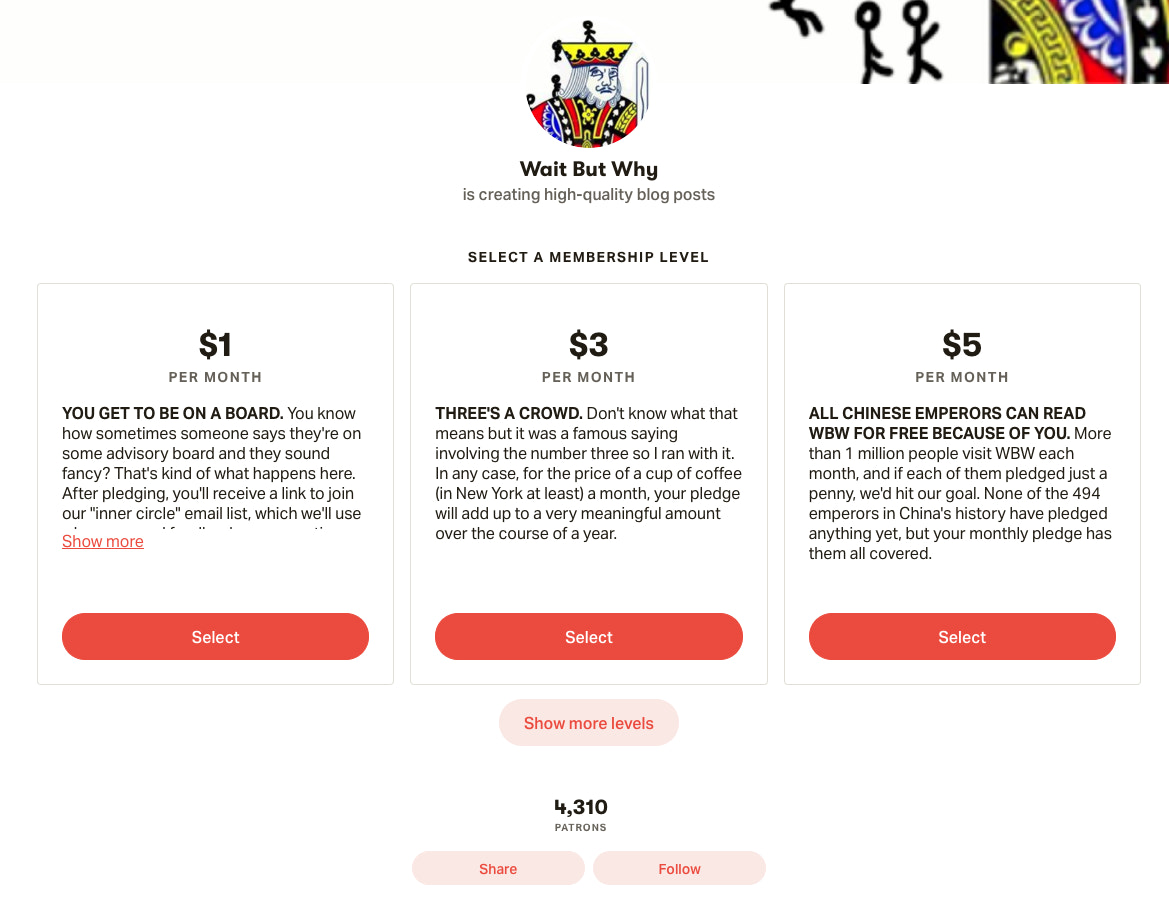


Wait But Why creates more long-form written content than YouTube videos, but is a great example of receiving support from the Patreon community.

If you choose the crowdfunding route, be sure to follow a couple of best practices. First, create transparency around how the money will be spent. This will get your fanbase invested in your story or mission, and they will literally buy into the value of your content. Second, offer enticing rewards for better pledges. The more you can make donors feel like they’re getting something exclusive for being a loyal fan, the more likely you are to get donations and higher pledges.

Some popular fan funding options include:
YouTube’s Super Chat: Super Chat is a feature used when going live on YouTube. It lets you create a tipping jar for your viewers to donate whenever and however much they feel like contributing. You’ll need to set up your YouTube account for advertising as outlined above.
Patreon: The membership platform that makes it easy for creators to get paid. Fans can subscribe to their favorite creators for as little as a dollar a month and receive exclusive rewards.
Tipeee: Lets you get a combination of both one-off and recurring donations

5. License your content to the media

If you happen to create a viral video with mass appeal—say, a funny clip featuring your dog—you can license your content in exchange for money.

TV news outlets, morning shows, online news sites, and other creators might reach out about rights to use your videos if they happen to go viral.

You can also list your videos in a marketplace, such as Juken Media, where your content will be easier for the right people to find and purchase.


When this video of a woman wearing a Chewbacca mask went viral, tons of media outlets wanted in.
 
6. Work with brands as an influencer or affiliate

Influencer marketing is going to be one of the advertising bedrocks of the next decade.Gary Vaynerchuk

Brands are investing more and more in influencer marketing, spending their typically large advertising budgets on influencers who’ve already won the loyalty of their audiences.

This creates a massive opportunity for you as a creator if you can negotiate the right deals.

Brendan Gahan, a YouTube marketing expert and influencer, recommends establishing your baseline flat fee by looking at the number of views your videos typically get and multiplying it by 5 to fifteen cents per view (which is around what many brands are willing to pay for views via YouTube ads).

Depending on your leverage—your audience demographics, content quality, and how unique and profitable your niche is—you might be able to negotiate a better deal if the brand is a good fit.

Becoming an influencer on YouTube is reported as the highest-paid platform for brand partnerships, according to Aqer. But to give you an idea of what you can potentially charge, a mid-level influencer charges a brand around $20 per 1,000 subscribers, or $2,000 per $100,000 followers, according to one study.

The key when partnering on brand-sponsored content is to be transparent about it, not endorsing anything you don’t actually like or believe in, and being upfront with your audience about why you’re doing it.

Here are just a handful of the many influencer marketplaces you can add your channel to and get discovered by brands both big and small:
Grapevine Logic: One of the more popular influencer marketplaces, you only need 1,000 followers to join.
Famebit: With a wide range of brands to work with, you might find a sponsorship opportunity you’ll be proud to be a part of. You need 5,000 followers to join.
Channel Pages: Partner with other YouTubers as well as brands.
Crowdtap: Complete small content creation “tasks” in exchange for money and other rewards. There’s no restriction on how many followers you need to join.

Some influencer marketplaces offer you free products, while others are known for having big brands who are willing to pay more. Capitalize on the opportunities that best suit your needs, but list yourself in as many places as you can to ensure maximum visibility for your channel.

Alternatively, you can also become an affiliate marketer for brands and make residual passive income through commissions from every sale you generate through your channel. This works especially well if you review products as part of your YouTube channel. Since there's no risk involved on the brand’s end (they only pay when they make sales), there's usually a low bar to getting started.

Popular affiliate programs include Click Bank(1% to 75% commission, depending on what the vendor sets) and Amazon's Affiliate network (earn up to 10% per sale). You can also reach out to brands in your niche that are running their own affiliate programs, which isn’t uncommon in the ecommerce space.
How to “sell” without annoying your audience

Many of the above strategies for monetizing involve promoting products or campaigns (e.g., crowdfunding a video series). But you’ll want to make sure your promotions don’t sabotage the integrity of your content.

“Selling out” is a real concern for a lot of creators. But if you never ask, you’ll never get.

There are a number of “placements” you can choose from for promoting products or campaigns.
Record a call to action in your videos

“If you liked this video, then hit the Like button and subscribe.”

Many YouTubers include a call to action along those lines at the end of their videos to grow their viewership. By suggesting the intended action you want them to take, your audience is more likely to take it.

You can adapt this approach to direct your audience’s attention to a revenue-generating opportunity.
Add well-timed YouTube cards to your videos

Whether it’s part of your deal with a brand or you’re promoting your own products, YouTube Cards offer an eye-catching way to get the attention of engaged viewers.

You can set them to pop up at just the right moment, when they’re most relevant and least distracting to increase their impact.


Add links in your video descriptions

You can funnel viewers to your store, Patreon page, Kickstarter campaign, or other revenue-focused part of your online presence by adding links to your video descriptions.


If you’re a video creator who wants to focus on generating revenue as an affiliate marketer, look at Unbox Therapy. Unbox Therapy specializes in product reviews, and it uses affiliate links in their video descriptions to make money via YouTube audiences. The channel is signed up as an Amazon affiliate. It places these unique links—pointing to the reviewed product on Amazon—in video descriptions. If the viewer purchases the item via clicking that link, the affiliate will earn a small percentage of revenue share paid to them by Amazon.

If you’re creating videos about your own products and you own or manage a Shopify store, you can incentivize new customers to buy your products with buy X get Y promotions or discounts.

Promote your offer on other platforms

Just because your content is hosted on YouTube doesn’t mean you shouldn’t be taking advantage of all the other distribution channels out there.

Spread the word about new campaigns or discounts on Twitter, Facebook, and any other profiles you own.

The more places your message lives, the greater the chance it’ll be seen. So it’s always a good idea to grow your following beyond YouTube with social media marketing.


Free Reading List: Social Media Marketing Tactics

Want to learn more about how social media can help drive sales? Download our free, curated list of high-impact articles.Get the free reading list
Are you ready to monetize your YouTube channel?

What compels most creators to create is rarely money. It’s the thought of making something for the world to enjoy.

But ironically, that puts them in a great position to actually make money in a content-obsessed world.

While the hard part for many businesses is getting and keeping their audience’s attention, YouTubers have already figured that bit out.

All that’s left is to get creative—to channel the entrepreneurial drive to explore ideas—with how you choose to monetize your passion.

Illustration by George Wylesol  
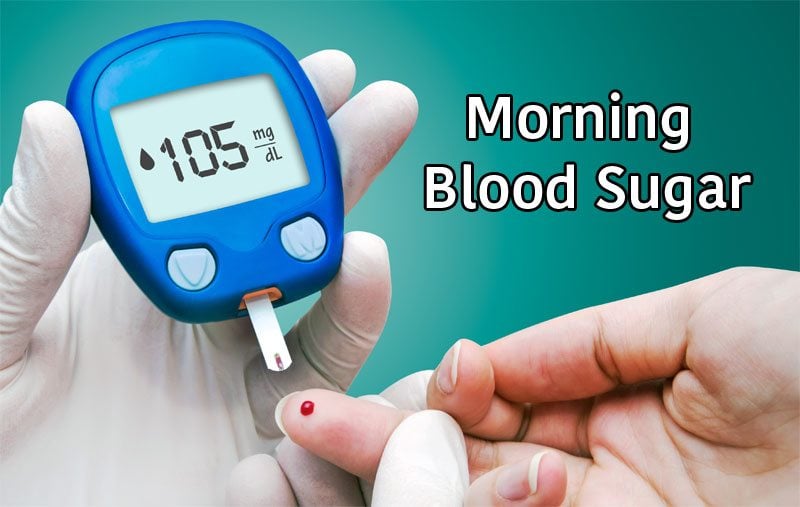
Why Is Blood Sugar High In The Morning?

High blood sugar in the morning is a popular topic – it seems to stump many people.

For instance, a while back I had a client sending me her blood sugar charts every few days and on those charts, she always made some notes if she had questions.

Every time she sent them through, I noticed she had 3 big question marks (???) against her morning readings. And on another morning when her morning blood sugar levels were high at 160 mg/dl (or 8.9 mmol/l).

She had written:

I don't understand. 97 mg/dl (or 5.5mmol/l) last night when I went to sleep. I didn't eat anything because I didn't feel well. Humm…

Here on the DMP blog we often receive comments like:
Why is my reading in the morning higher than when I go to sleep?
My morning numbers are always high no matter what I do. When I say high I mean 190. I am so frustrated and don't understand why.
Why does my blood glucose spike in my sleep giving me a high reading in the morning when I watch all I eat at dinner time?

Do these morning situations sound familiar to you? Are you constantly questioning why you have high blood sugar in the morning?

Logically we'd think that it should be at its lowest in the morning, right?

Well don't panic, there is a reason for it, so let's explore why morning blood sugar is often higher. And then we’ll discuss what you can do to help lower blood sugar in the morning.


Why Is Blood Sugar High In The Morning?

Although it would seem logical that your body would have the lowest blood glucose level in the morning, this often isn’t the case for the following 6 reasons.
1. Glucose Happens 24/7

All the cells in the body need glucose to fuel their function, even when we sleep.

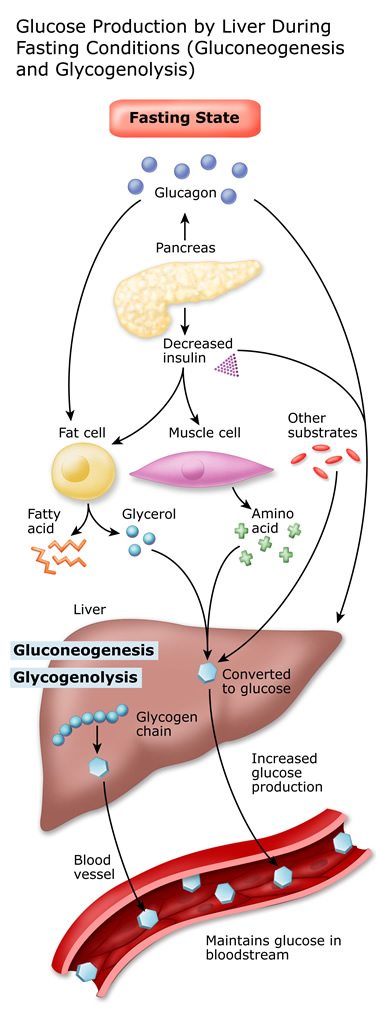
Therefore the liver can produce sugar (glucose) by breaking down body stores (glycogen), a process called glycogenolysis. The liver can also manufacture sugar (glucose) from amino acids (proteins) in a process called gluconeogenesis.


Image courtesy: University of California

These processes ensure the body and brain have adequate fuel so they can continue to go about their functions.

The point is: glucose production in the body will still occur when you don't eat or if you skip a meal because the body always maintains glucose at a certain level in order to function.
2. Hormones Raise Blood Glucose (the Dawn Phenomenon)

Around 3-4 am each morning, there are a collection of counter-regulatory hormones that are signaled in the body: glucagon, epinephrine, growth hormone, and cortisol, which result in a rise in blood sugar.

This change in hormones occurs to stimulate our awakening, to get us moving and to give us energy. This is referred to as the Dawn Phenomenon or Dawn Effect.

This is, in fact, a ‘normal' response. This occurs in everyone, diabetic or not.

However, if you have diabetes or prediabetes there is one additional factor that impacts both the overnight glucose production and the rise in glucose with cortisol, and that is decreased insulin production or decreased utilization of insulin.
3. Decreased Insulin Production or Utilization of Insulin

Because most people with type 2 diabetes and prediabetes have either decreased insulin levels or decreased utilization of insulin, there is either not enough insulin being produced to bring the rising blood sugar levels down, even during the night when you are sleeping.

In this scenario, your body is still producing glucose, your hormones are still doing their thing, but insulin production is low so your body is unable to counteract the effects of the glucose and hormone change.

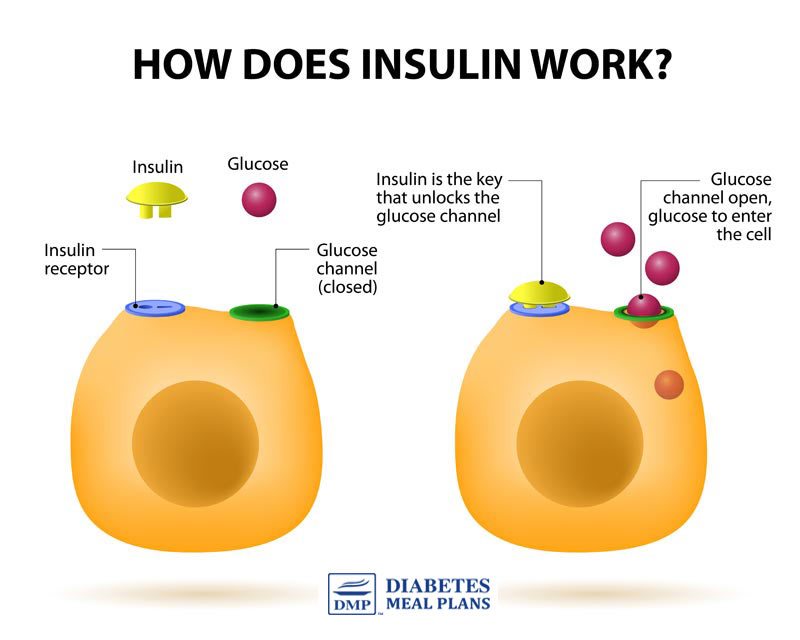
The other scenario is that your levels of insulin resistance are preventing effective utilization of insulin, which results in high levels. You may be producing sufficient insulin, even during the night, but your cells are not opening in response to insulin, therefore glucose remains in the bloodstream.


4. Hypoglycemia is known as the Somogyi Effect

This is less common but in some people with diabetes, low blood sugar (hypoglycemia) can occur while you are sleeping.

The Somogyi effect is more common in diabetics who are insulin dependent. It's when your body's glucose levels decrease quite significantly overnight (nocturnal hypoglycemia) and as a result, your emergency system is activated. This sends messages to your hormones and organs to stimulate more glucose production to help raise your levels.

If you're insulin dependent and trying to identify why your blood sugar is so high in the morning, you might want to wake yourself up during the night to test your levels, just in case this might be your situation and your insulin dose needs to be adjusted, for instance, implementing a long-acting insulin. Or in some cases, people may choose to use a continuous insulin pump.

You can read more about the Somogyi effect here.

5. Poor Food Choices

Poor food choices have a profound impact on your blood glucose and A1c levels, and therefore your early morning levels too.

Regardless of the time of day, poor food choices will impact your glucose levels negatively.

Your goal is to clean up your diet and stick to eating recommended foods that support good blood sugar control.

6. Poor Overall Glucose Control

If your daily averages are coming in well above the normal healthy range for blood sugar levels, chances are your fasting levels are going to be high as well.

Good blood sugar control means keeping your blood sugar levels as close to normal as possible. And if you can keep them within the healthy range, that’s even better.

You need to know your numbers…

Aim for fasting levels:

Between 70-100 mg/dL or 4-5.6 mmol/l (optimal)
70-110 mg/dL or 4-6 mmol/l (considered good control)
70-130 mg/dL or 4-7.2 mmol/l (more liberal, but realistic for many)
2 hrs post meal the ideal is under 140 mg/dl or 7.8 mmol/l – the lower your postprandial blood glucose is post meal (for instance 120/ 6.7), the better.

There is some variation in numbers worldwide and your physician may also set you more stringent goals, or more lenient goals.

The point is: keep an eye on your numbers. If you've constantly got numbers that are running high during the day, chances are they are going to be even higher in the mornings.

Your goal is to bring your blood sugar levels within a healthy range, then naturally the morning levels do come down as well.

Still, even when you have good control of your daily levels, those morning numbers may still be a little high.

So what can you do? Let’s look at some proven strategies.


Lifestyle Strategies To Lower Morning Blood Sugar Levels

The truth is, that despite the fact we know the Dawn Phenomenon exists and worsens morning blood sugar in those with diabetes and prediabetes, researchers still haven’t solved exactly how to lower morning levels.

However, try some of the following methods to see if they work for you. Every person is different and while there is no one proven method for lowering morning levels, many people do report one, or a combination of the following helps. 

Apple Cider Vinegar & Cheese Before Bed

One small study found that having 2 tablespoons of apple cider vinegar with 1 oz (28 g) cheese (which is just 1 slice cheese) before bed may help reduce morning glucose by 4% to 6%.

Cheese on its own may reduce it by 2% but the acetic acid in the vinegar exerts additional positive influence. The best apple cider vinegar to use is this one by Braggs.

Have a Bedtime Snack

The best type of snack is a protein/fat snack combined, not something high in carbs.

Here are a few ideas:

A tablespoon of natural peanut butter (great on pieces of celery for some fiber filling goodness)
A small piece of chicken with avocado or 5 olives
A small handful of macadamia nuts
A couple of slices of cheese
Sleep Soundly

Make sure you get a good restful sleep every day because lack of sleep can increase cortisol production (your key stress hormone) and this pushes glucose levels higher. Sleep quality has a big influence on blood sugar levels.

Avoid Alcohol

Although drinking alcohol might seem relaxing it is best to steer clear of it because it’s actually a stimulant and prevents deep REM sleep.

Eat Protein In The Morning

To help bring blood sugar levels down, eat something when you get up but make sure it’s a protein – or a balanced protein/fat/veggie breakfast such as a mixed veggie egg scramble.

If you go and eat loads of carbs for breakfast when your blood glucose is already high, it will only push it up further. The message here is: toast and cereals are often the worst offenders.

Eat Well Every Day

Morning blood sugar levels are all tied up with everything else you do throughout the day.

And one of the best ways to manage your diabetes or prediabetes is to eat a healthy diet every day – eat the right type of carbs, eat the right amount of carbs, and minimize the most problematic foods – the high carb offenders: sugar, bread, rice, pasta, cereals, and potatoes.

The food you eat has a direct impact on your blood sugar and A1c levels. And the more controlled you can keep your blood sugars overall, the better your morning sugars will be as well.

You'll find plenty of diet resources on our website. And if you need further help, consider joining as a member.
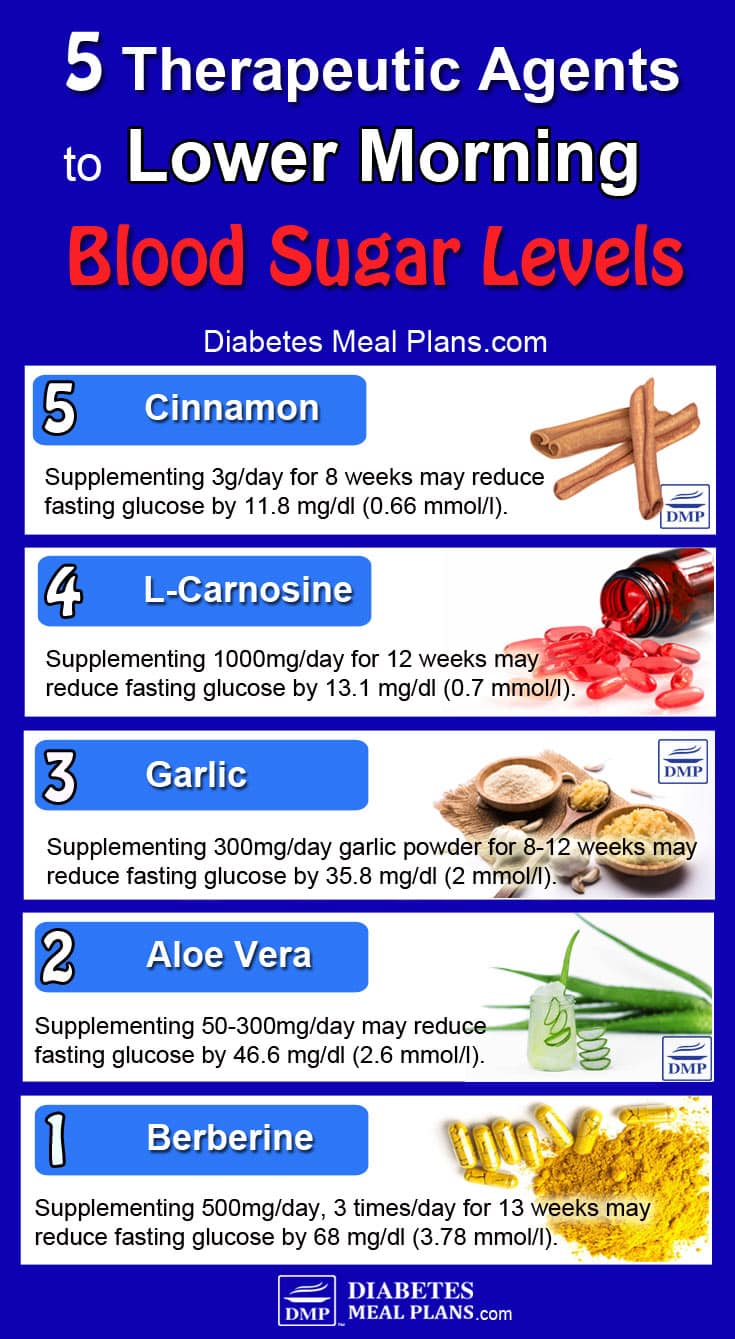
Supplements to Help Lower Morning Blood Sugar Levels

A variety of supplements have been shown to be effective in reducing fasting glucose levels.
Cinnamon

The average results from two months of cinnamon supplementation at about 3g/day is a reduction in fasting blood glucose by 11.8 mg/dl (0.66 mmol/l).

Polyphenols in cinnamon provide many benefits such as enhancing insulin signaling, improving glucose transport into cells, and reducing insulin resistance.
Chromium

A review of chromium supplementation found that fasting blood glucose can be reduced by 9 mg/dl (0.5 mmol/l) to 31 (1.72 mmol/l).

Researchers suggest this is due to enhancement of insulin action.

Garlic

Taking approximately 300 mg of garlic powder for 8-24 weeks has been shown to reduce fasting blood glucose by approximately 35.8 mg/dl (2 mmol/l).

Researchers suggest garlic helps enhance insulin sensitivity, exerts insulin-like activity, enhances pancreatic beta cell function and inhibits carbohydrate metabolism.
L-Carnosine

L-carnosine 1000 mg per day for 12 weeks showed a 13.1 mg/dL (0.7 mmol/l) reduction in fasting blood glucose levels.

L-carnosine is naturally found in muscle tissue and when taken as a supplement helps modify glucose metabolism, provides antioxidant, protects against glycation and reduces inflammation.
Aloe Vera

A review of aloe vera found a reduction in fasting glucose levels by 46.6 mg/dL (2.6 mmol/l). Aloe vera was either taken by supplement 50-300 mg per day, or juice 15 – 30 mL.

Although the exact mechanisms are unclear, proposed mechanisms include the expression of the genes related to glucose metabolism and reduced insulin resistance. Aloe vera contains over 75 active components, some of which are trace elements of chromium, magnesium, manganese, and zinc that are important in the metabolism of glucose.

Berberine

The effects of berberine on fasting blood sugar levels is very impressive. When people with type 2 diabetes were given 500 mg of berberine per day, 3 times per day, for 13 weeks, fasting blood glucose reduced by 68 mg/dL (3.78 mmol/l).

Berberine has many potent glucose-lowering properties. If you’d like to learn more about it, we’ve written about berberine extensively over here.

Many of the above supplements have also been shown to control blood sugar overall, along with lowering A1c, as well as providing several other benefits.

The best rule of thumb here is not to go out and take every single supplement, but try taking one supplement for a time and see if it exerts any benefits for you. If not you can try exchanging it for another one to evaluate its effects.

Always be aware that any blood sugar lowering supplements can potentially cause low blood sugar (hypoglycemia). You should always seek medical advice before supplementing, especially if taking medications.

Please pin, tweet or share; then keep on reading – thanks!


Unfortunately there is no one size fits all solution to solve the high blood sugar in the morning dilemma. Sometimes people can do everything possible and still have morning levels that always come in a little high.

Hopefully in the near future, researchers will uncover a way we can solve the issue more permanently. But in the meantime, the best thing you can do is bring your daily levels down within a healthy range and maintain them there, as this will also influence morning levels.

Second to that you can try some of the strategies above to see if they make a difference for you.

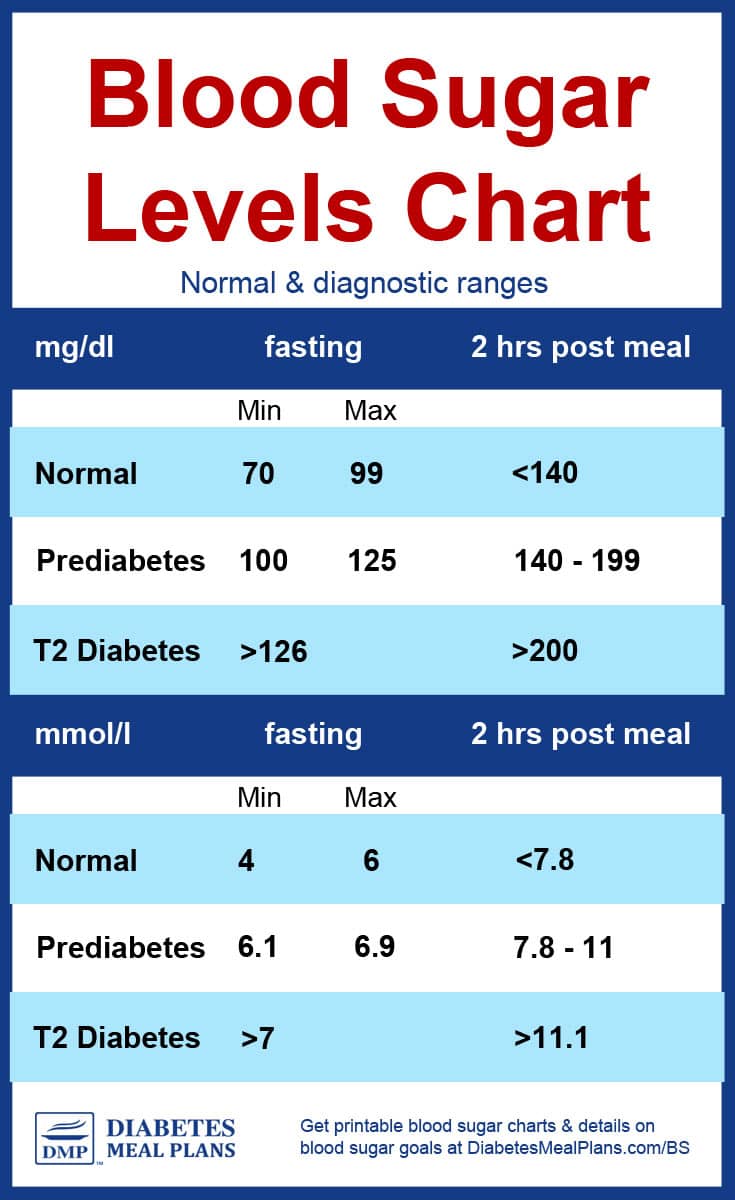
Diabetes Blood Sugar Levels Chart


Normal Blood Sugar Levels

Fasting glucose – 70-99 mg/dl or 4-6 mmol/l (Note: there is some debate about the normal range in mmol/l, ranging from 5.5 to 6 mmol/l)

2 hours post meal glucose – Less than 140 mg/dl or less than 7.8 mmol/l

Pre-diabetes – also called impaired fasting glucose or impaired glucose tolerance

Fasting glucose – 100-125 mg/dl or 6.1-6.9 mmol/l

2 hours post meal glucose level – 140-199 mg/ dl or 7.8-11 mmol/l

Diabetes

Fasting glucose – More than 126 mg/dl or more than 7.0 mmol/l

2 hours glucose level – More than 200 mg/dl or more than 11.1 mmol/l


Blood Sugar Levels Chart

The above chart and the one below are exactly the same, in different formats.
Category Fasting value Post prandial / aka post meal
Minimum Maximum 2 hours after meal
Normal 70 mg/dl 99 mg/dl Less than 140 mg/dl
4 mmol/l 6 mmol/l Less than 7.8 mmol/l
Pre-diabetes 100 mg/dl 125 mg/dl 140-199 mg/dl
6.1 mmol/l 6.9 mmol/l 7.8-11 mmol/l
Diabetes More than 126 mg/dl More than 200
More than 7 mmol/l More than 11.1 mmol/l


These are the diagnostic ranges. As you can see, the “normal” range for fasting glucose is under 100 mg/dl or 6 mmol/l. Though just to note, there is some debate about the normal range in mmol/l, ranging from 5.5 to 6 mmol/l. So depending what chart you look at, you may see either of those numbers.

After a meal, the maximum reading you ideally want to see is 140 or 7.8.

If you're getting readings above this, you would be diagnosed with prediabetes or type 2 diabetes, as shown in the charts above.

Diabetes Blood Sugar Level Goals

Upon waking before breakfast (Fasting)
70-130 (Ideal under 110) mg/dl
4-7.2 (Ideal under under 6.1) mmol/l

Two hours after meals
Under 180 (Ideal is under 140) mg/dl
Under 10 (Ideal is under 7.8) mmol/l

Bedtime
90-150 mg/dl
5-8.3 mmol/l

The above levels, for people diagnosed with type 2 diabetes, are the general goals set by the American Diabetes Association and the American Association of Clinical Endocrinologists.

As suggested earlier, there is some variation in the blood sugar levels goals set by different organizations. And additionally, your physician or healthcare team may set your goals at a more stringent level.

For instance, fasting levels:
Between 70-100 mg/dL or 4-5.6 mmol/l (optimal)
70-110 mg/dL or 4-6 mmol/l (still good control)
70-130 mg/dL or 4-7.2 mmol/l (more liberal, but realistic for many)

Once you have a type 2 diabetes diagnosis, the overall goals you should aim for is to get your blood sugar levels as close to “normal” “optimal” levels as you possibly can.

BUT, as suggested above, often goals are set with higher targets initially. For instance, if you have a high reading of 250 or 300 (13 or 17), your physician or health practitioner may recommend 200 (11.1) be an initial goal, then 180 (10), before gradually working toward 140 (7.8) and lower.

The reason this is often recommended is you can experience symptoms of hypoglycemia(low blood sugar) if you bring your levels down very quickly. So working toward tighter and tighter control does take some time.

You should work with your healthcare team on this. But overall the most optimal targets to work toward are a fasting glucose under 100 mg/dl or 6 mmol/l. And an after-meal reading below 140 or 7.8.

The Visual Version

Please pin, tweet or share this chart to help others – thanks!


Commonly Asked Questions About Blood Sugar Levels

What is the difference between blood sugar and A1c?

Blood sugar is a daily reading while A1c is a blood test that measures your average blood sugar from the previous 3 month period.

 Will weight loss help with my diabetes management?

Yes, by default weight loss helps because it reduces inflammation in your body and improves overall metabolic function. However, weight loss alone won't lower blood sugar levels. You often have to make several diet and lifestyle changes to bring your levels within normal range.

I've been prescribed Metformin, will that help with my blood glucose levels?

Yes, Metformin is one of the most commonly prescribed diabetes medications worldwide. It belongs to a class of medications known as “Biguanides,” which lower blood glucose by decreasing the amount of sugar put out by the liver. And it is one of the medications that does not increase weight gain.

Why does high blood sugar cause complications like neuropathy?

The body is designed to have a blood sugar level within a certain range, with a maximum of 140 (7.8) after meals. Levels above normal for extended periods promote inflammation in the blood vessels throughout the body, along with damage to cells – simply because the body isn't designed to operate with levels above normal.

Diabetic neuropathy is damage to the nerve vessels resulting from chronically high blood sugar – meaning long-term, not a few high readings now and then. Other types of diabetes complications (nephropathy, retinopathy, etc) are also caused by the same factors.

What type of diet helps to lower blood sugar levels?

Scientific research indicates that a low carb diet is a great dietary pattern for improving blood sugar, A1c, weight, cholesterol, and other factors.

Carbohydrates are the main nutrient that influences your blood sugar levels. The type is important, but the amount has the greatest impact on both daily blood glucose and A1c measurements.

 Is there a different blood sugar levels chart by age?

No. The human body was designed to have blood sugar levels within a ‘normal' range, regardless of your age.

However, different blood sugar level goals are set for each individual person, particularly children and the elderly.

The diabetes organization in my country lists different levels, why are these different?

It can make it confusing when different organizations list different values. And unfortunately, there is no one recognized value at this point, although there should be.

Here are the organization listings for some parts of the globe:

American Diabetes Association

List the normal range between 70-99 mg/dl (3.9-5.6 mmol/l).

They suggest blood glucose goals for people with type 2 diabetes are:
80-130 mg/dl before meals (4.4-7.2 mg/dl)
Less than 180 mg/dl after meals (10 mmol/l)

Diabetes Australia

List the normal range between 4.0-7.8mmol/l.

They suggest blood glucose goals for people with type 2 diabetes are:
6-8 mmol/l before meals (108-144 mg/dl)
6-10 mmol after meals / 108-180 mg/dl

Diabetes UK

List the normal range between 4-6 mmol/l (72-108 mg/dl) when fasting. And up to 7.8 mmol/l (140 mg/dl) 2 hours after eating.

They suggest blood glucose goals for people with type 2 diabetes are:
4-7 mmol/l before meals (72-126 mg/dl)
Under 8.5 mmol/l after meals (153 mg/dl)

Diabetes Canada

Like Diabetes UK, they suggest blood glucose goals for people with type 2 diabetes are 4-7 mmol/l before meals (72-126 mg/dl).

5-10 mmol/l after meals (90-180 mg/dl), or if A1c goals are not being met, it should be reduced to 5-8 mmol/l (90-144 mg/dl).

Hopefully, we will see organizations worldwide list the same glucose readings in future so there is not such a confusion.

Can these charts be used as a pre-diabetes blood sugar levels chart?

Yes. The charts contain the numbers for prediabetes as well. And you can use the charts to track your food intake and daily numbers, along with exercise or other notes you want to include.

Is daily blood glucose monitoring recommended?

If you have type 2 diabetes or prediabetes, daily self-monitoring using a blood glucose meter(which involves a simple finger-prick test), can be a great way to understand what is happening in your body so you can bring your levels under control.

How often should I take a blood sugar sample?

There is wide variability on how often to monitor, depending on the state of your diabetes and treatment. But, most people monitor 1-2 times daily – fasting (first thing in the morning) and 2 hours after the biggest meal. For your after-meal (postprandial) blood sample, time from your first bite of food.

If you’re newly diagnosed or trying to gain better control, it can be helpful to monitor more frequently so you can assess your progress and work on changing diet and lifestyle habits to support your goals.

One thing that is helpful with mealtimes is “monitoring in pairs.” To monitor in pairs you check your levels before, then 2 hours after a meal. It’s a great way to get an indication of the effect of foods and the number of carbs you’re consuming. If you log your numbers and your daily food intake and lifestyle habits, you will soon see patterns emerging and then you can make the necessary adjustments to your dietary routine.

When you download our free blood sugar chart below, we'll also provide some blood sugar logs so you can record your blood sugar readings.

Well, there you have it. Hope you find this information helpful and if you do please pin it and share it around to help others. Thanks!

Please pin, tweet or share this info to help others – thanks!


Source: http://diabetesmealplans.com/

7 Best Pre-Workout Supplements for Women to Take to Step-Up Their Workout Game

 More and more women today are using pre-workout supplements to enhance their workouts and the overall effect of the work they are doing. There are thousands of potential pre-workout powders as well as protein powders available for muscle growth and to help improve the blood flow, such as beta alanine, creatine monohydrate, nitric oxide, amino acids, and even green tea. Many of them are marketed to men but can be used by women. There are also pre-workouts that you can make on your own from ingredients in your own kitchen.

If you’re a woman looking for the best pre-workout for muscle growth on the market, which should you consider?


This is a great question!


First of all, you’re going to want to choose a pre-workout based on your fitness goals. For instance, if you want to build muscle you can try a pre-workout that has the usual amount of creatine monohydrate—the type of pre-workout that is typically geared toward men. However, if you want to tone your muscles without bulking up, it’ll be better to choose a pre-workout with reduced creatine. Women tend to use cardio in their workouts more than men so the slight dehydrating effect of creatine in a pre-workout can lead to muscle cramps during your workout, too.


Keep in mind that creatine is not “bad for women” and they can use it if they want to bulk up. Of course, this isn’t to say that creatine alone will result in a big, bulky look for a woman. It helps build muscle, improvements strength, improves endurance, and helps you maintain lean mass. It just isn’t the best option for a pre-workout if you intend to use cardio.

It’s also a good idea to check the ingredients of your pre-workout for testosterone-boosting ingredients. These include things like Tribulus, D-aspartic acid, and fenugreek. You’ll want to stay away from those if you’re female.

Benefits of a Pre-Workout

Pre-workouts offer a variety of benefits. They give you a boost of energy and improve blood flow to help you get through your workout. They also feature focus enhancers, so you’re able to get more accomplished in the same amount of time.

Pre-workout supplements that are geared to women also feature a few added benefits. For instance, many have high-energy fat burning complexes. Not only does this give you more energy during your workout, it can have lasting effects regarding energy.

Whether you’re need something to help you maintain the same level of energy by the end of your workout that you have at the beginning or you want something that will give you an added boost when it comes to losing fat, a pre-workout can be very effective.

Let’s look at the top 7 pre-workout supplements for women out on the market today!

Naked Energy – Unflavored All Natural Pre Workout Supplement


Manufactured in the USA, Naked Energy is an all-natural pre-workout energy supplement that contains 10 high-quality ingredients such as natural amino acids, vitamins, and caffeine from unroasted coffee beans. Vegan-friendly Naked Energy prides itself on offering a pre-workout supplement that has no added sugars, fillers, artificial sweeteners, colors or flavors. This pre-workout supplement is also third-party tested for safety, purity, and nutritional value. This product received high ratings on Amazon proving that customers love this product as their pre-workout supplement choice. 

Red Leaf Pre-Workout Energizer

Hitting the number 2 spot on our top 7 pre-workout supplements for women is Red Leaf Pre-Workout Energizer. What makes this particular pre-workout supplement a top choice for women is the inclusion of beta-alanine, which delivers carnosine to your muscles that reduces fatigue and fuels workout intensities. With a “modest dose of pure caffeine,” you are sure to feel less of those caffeine jitters and more of a boost than other pre-workout supplements! With over 1,000 customer reviews on Amazon, you cannot go wrong with this pre-workout supplement!


Purigami Natural Pre-Workout Powder for Women


Purigami's Natural Pre-Workout powder is a supplement specifically designed for women with ingredients that are void of caffeine bombs, creatine, and t-boosters that are commonly found in formulas designed for me. Women who take this supplement can rest assured that they are getting vegan-free, non-GMO, gluten-free, no sugar added, and no artificial ingredients supplement to help them perform at their best during their workout!


Strong Girl Pre-Workout


Many who have used Strong Girl Pre-Workout reported that it provided them with the intensity they needed to get through the toughest phase of their workout that usually left them depleted. They also reported no upset stomach after taking this supplement. With green tea, l-carnitine, quercetin, this pre-workout supplement has been tested and loved by women.


IdealLean, Pre Workout Fo r Women


This specially designed formula for women boasts many great elements that are sure to give you the boost you need for your intense workout! With fat burners and natural caffeine, IdealLean Pre Workout for Women provides a supplement that will help you focus during your workout and endure the longer and harder workouts. Plus, the two flavors are delicious: Watermelon Ice or Blue Raspberry! You can’t really go wrong. One of the key comments was that the supplement tasted amazing. Sometimes taste can be a bit of a downfall for powders and supplements, but IdealLean got it right here, too!


Wurx Nutrition Her All-In-One Advanced Pre Workout Women’s Supplement Powder for Endurance


This pre-workout allows women to enjoy a supplement that is specifically designed for them with each ingredient carefully selected and dosed FOR them. Women no longer have to worry about “bulking up” too much with this supplement as it boosts metabolism and helps maintain an ideal female body composition. With organic caffeine paired with Alpha GPC, women are guaranteed to experience extreme mental focus without all of the unnecessary jitters.

Buy the Wurx Nutrition Her on Amazon


Chick Pump The Best Pre Workout Supplements for Women!


Everyone woman is after energy, toned muscle, great moods, and awesome strength, and that’s exactly what Chick Pump does for women as their pre-workout supplement! Without any crash or jitters found in other pre-workout supplements, this formula is sure to provide the best possible experience for women and their workouts. Women taking this pre-workout supplement noted the taste was great, energy was high, and less formula needed to be used.


Though this list can help you choose a pre-workout that meets your needs, the best way to make your decision is by trying a few different pre-workouts. Not every pre-workout is going to work the same for everyone. One person can tell you what they think is the best, but its effects might be totally different for your body. And this is assuming you have the same goals as another person.

If someone is hoping to get a blast of energy to get them through a tough workout at the end of a long day, but you’re looking for something that offers energy and other benefits, your choices for what is “best” are going to vary. Not to mention how your goals might change over time—what you want from your workout today could be completely different a year or two from now.

Your best bet is to make a list of your workout goals and look for pre-workouts that claim to meet these goals.

Resources

Creatine Supplementation and Exercise, International Society of Sports Nutrition

Effects of Creatine on Performance and Training, Journal of Molecular and Cellular Biochemistry

Creatine Side Effects & Warnings, Mayo Clinic

Just 2 Sips, Your Belly Fat Will Disappear And Your Metabolism Will Be Faster Than Ever!


Put These 2 Ingredients in Your Coffee.


There’s no doubt coffee is the most enjoyed morning drink throughout the world. For one thing, it instantly boosts your energy levels and prepares you for the day ahead. Plus, it packs a number of other health benefits, such as improved metabolism, and when consumed moderately, it protects your heart.

But, few people know that you can turn your favorite morning brew into a powerful fat burner by just adding a few common ingredients such as coconut oil, cinnamon, and honey. If you mix these ingredients into your coffee, you’ll easily drop a few extra pounds without having to make any dietary or lifestyle changes.


The most popular online store in the world, the best discounts and bonuses are waiting for you! Fast delivery and the ability to exchange goods. 

Why Is This Combination So Powerful?

1# Cinnamon provides numerous health benefits. It’s a powerful anti-inflammatory agent which reduces inflammatory processes in the body. Plus, it’s full of antioxidants meaning it neutralizes the negative effects of free radicals. It also reduces blood sugar levels by increasing blood sugar metabolism. It supports the breakdown of sugar, which is transformed into energy. In this way, cinnamon prevents fat buildup in your body. The most popular types are Ceylon and Cassia cinnamon.

2# Coconut oil is another gift from nature which provides a long list of health benefits. It mostly consists of medium-chain fatty acids, which the digestive system immediately sends to the liver. If they are not turned into energy, they are transformed into keton bodies meaning they aren’t stored as fat. The best advantage of coconut oil for weight loss is that it naturally sets the metabolism to burn fat more efficiently.

The most popular online store in the world, the best discounts and bonuses are waiting for you! Fast delivery and the ability to exchange goods. I recommend! CLICK THIS SHOP


3# Honey may be full of sugar, but this is natural sugar that the body depends on for energy. Honey is also abundant in important minerals such as sodium, iron, zinc, calcium, potassium, and phosphorus. Plus, honey contains niacin, folate, vitamin C, riboflavin and Vitamin B6. It has proved highly beneficial for regulating blood cholesterol levels and reducing stress.
Now, the fat burning process in the body largely depends on minerals and vitamins. This is where honey steps in. It provides the essential nutrients thus preventing any mineral or vitamin deficiencies in the body. Raw unpasteurized honey is the healthiest.

What you need:
– ½ cup of honey
– ¾ cup of coconut oil
– 1 tsp. of cinnamon
– 1 tsp. of cocoa (optional)

What you do:
Make a well-blended paste by mixing all the ingredients together. Store in a glass jar and keep in the fridge.

How to use it:
Add 1-2 teaspoons of the mixture in a cup of freshly brewed coffee. Stir well and enjoy your morning fat-burning cup of coffee!


Every Woman Should Know These 15 Tricks With Baking Soda


People knew about useful properties of baking soda from the times of Ancient Egypt. Now we know about 300 ways of its usage, which housewives from all over the world have used for many centuries.

In this article you will learn fifteen most popular of them.We are sure you all have baking soda at home. But do you use it only for baking? Well, this versatile and cheap tool can be used not only to relieve the symptoms of heartburn or to bake pies. If you choose the list of products that should always be at hand, baking soda would be, perhaps, the first in the list.


This is a universal and widely available product. Baking soda will help you throughout the house, for personal hygiene, and also for dealing with unwanted insects and will simply make everything much easier. Put off all those cleaners and other items purchased at the hardware store, they are so harmful for your health and pollute the environment!

Start using baking soda in all corners of the house and for personal hygiene. You can use it also for cosmetic purposes. For example, for your skin and hair, for struggling with stretch marks and whitening your teeth. Look through all methods of its usage:

#1. Natural deodorant.
Stop using chemical deodorants..

#2. Insect bites.
It will ease irritation.

#3. Heartburn.
You will relieve heartburn.

#4. Scrub.
It can fight with skin imperfections like wrinkles, blackheads and tarnished skin.


#5. Hair.
It can increase hair growth.

#6. Stretch marks.
It will reduce visible stretch marks.

#7. Bad breath.
It will help you fight this problem.

#8. Rough skin.
Put on warm socks with baking soda and forget about this unpleasant situation.

#9. Stains.
Baking soda can remove stains.

#10. Fridge smell.
It fights with unpleasant smell in your fridge.

#11. Jewelry.
It is able to return your jewelry previous shine.

#12. Abscesses.
It is useful as an abscess treatment.

#13. Sunburn.
Soothe burnt skin with baking soda.

#14. Peas and beans softener.
Get peas and beans ready for cooking quicker.

#15. White teeth.
Brush your teeth and make them whiter.


Sharing is caring!

Facebook
Twitter
Pinterest


Facebook Comments


Copyright

NoelGRSr 2016